Electric vs. Diesel Forklifts: Which Drives Your Business Forward?
For decades, the choice was simple: If you worked outdoors, you bought diesel. If you worked indoors, you bought electric.
But the rules have changed.
With the rise of high-voltage Lithium-ion technology—spearheaded by innovators like Hangcha—the line between “indoor” and “outdoor” forklifts has blurred. Today’s fleet managers aren’t just comparing fuel types; they are calculating Total Cost of Ownership (TCO), environmental impact, and operational efficiency.
In this guide, we’ll put the two heavyweights of the material handling world head-to-head. Whether you are running a construction site, a logistics center, or a manufacturing plant, this comparison will help you decide which power source is right for your bottom line.
The Diesel Defender: Raw Power & Tradition
Diesel forklifts (IC Pneumatic) have long been the backbone of heavy industry. Known for their ruggedness, they are the traditional choice for outdoor applications like lumber yards, ports, and construction sites.
How It Works
Powered by an Internal Combustion (IC) engine, these forklifts operate similarly to a car or truck. They generate high torque at low RPMs, making them excellent for pushing heavy loads and climbing steep gradients.
The Advantages of Diesel
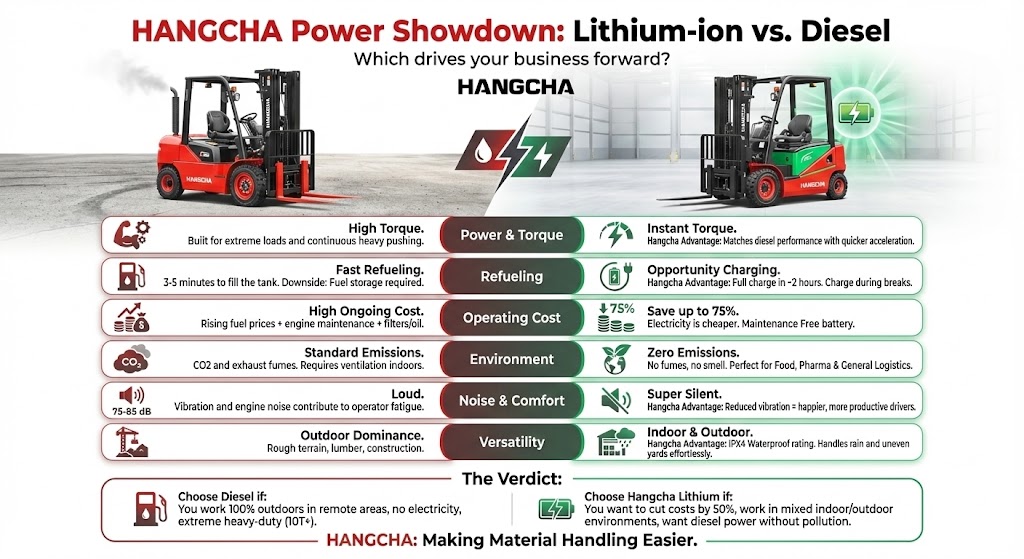
- High Torque & Power: Diesel engines provide consistent, raw power, making them ideal for lifting heavy loads (10T+) or using heavy hydraulic attachments.
- Fast Refueling: There is no downtime for charging. A tank can be refilled in 3-5 minutes, allowing for continuous operation.
- No Infrastructure Required: Unlike electric trucks, you don’t need to install charging stations or upgrade your facility’s electrical grid.
- Lower Upfront Cost: Generally, a diesel forklift has a lower initial purchase price compared to a lithium-ion equivalent.
The Disadvantages of Diesel
- High Operating Costs (High Opex): While cheap to buy, they are expensive to run. You are paying for fuel, frequent oil changes, filter replacements, and engine maintenance.
- Noise & Vibration: Operating at 75–85 dB, diesel trucks are loud. The engine vibration contributes to operator fatigue over long shifts.
- Emissions: They produce exhaust fumes (CO2, NOx), making them unsuitable for indoor use or strict “Green Zones” without expensive modifications.
The Electric Evolution: From Lead-Acid to Lithium
When people think of “Electric Forklifts,” many still picture the old technology: slow, lead-acid batteries that require 8 hours to charge and dedicated watering maintenance.
Forget that image.
Modern electric forklifts—specifically Hangcha’s Lithium-ion (Li-Ion) and High-Voltage series—have revolutionized the market.
How It Works
These forklifts use an electric motor powered by a battery. While traditional models use heavy Lead-Acid batteries, modern Hangcha units utilize advanced Lithium Iron Phosphate (LiFePO4) packs—the same tech found in EVs.
The Advantages of Electric (Lithium-ion)
- Massive Cost Savings: Electricity is significantly cheaper than diesel. Plus, with maintenance-free batteries (no oil changes, no engine parts), you can reduce your maintenance costs by up to 30-50%.
- Opportunity Charging: Unlike lead-acid, Hangcha’s lithium batteries can be charged during coffee breaks or lunch. You can get a full charge in ~2 hours, enabling 24/7 multi-shift operation.
- Zero Emissions: No fumes, no smell. This is mandatory for food, beverage, and pharmaceutical industries, and increasingly required for green logistics certifications.
- Instant Torque & Speed: Contrary to the myth that electric is “slow,” high-voltage electric motors provide instant torque acceleration, matching the productivity of internal combustion engines.
The Disadvantages of Electric
- Higher Upfront Investment: The initial purchase price of a Lithium-ion forklift and its charger is higher than a diesel unit (though the ROI is usually recovered within 18-24 months).
- Battery Management: While lithium is easier than lead-acid, you still need to ensure drivers plug the trucks in during breaks to maximize efficiency.
Wait, Can Electric Forklifts Go Outside?
This is the most common question we get at Hangcha.
The Answer: Yes.
Old electric forklifts were fragile and hated the rain. However, the new generation, such as the Hangcha XE and XH Series, is built with IPX4 and IP54 water resistance. They feature high ground clearance, large pneumatic tires, and sealed components.
This means you can now use a clean, quiet electric forklift in the yard, in the rain, and on uneven surfaces—effectively killing the main advantage diesel used to hold.
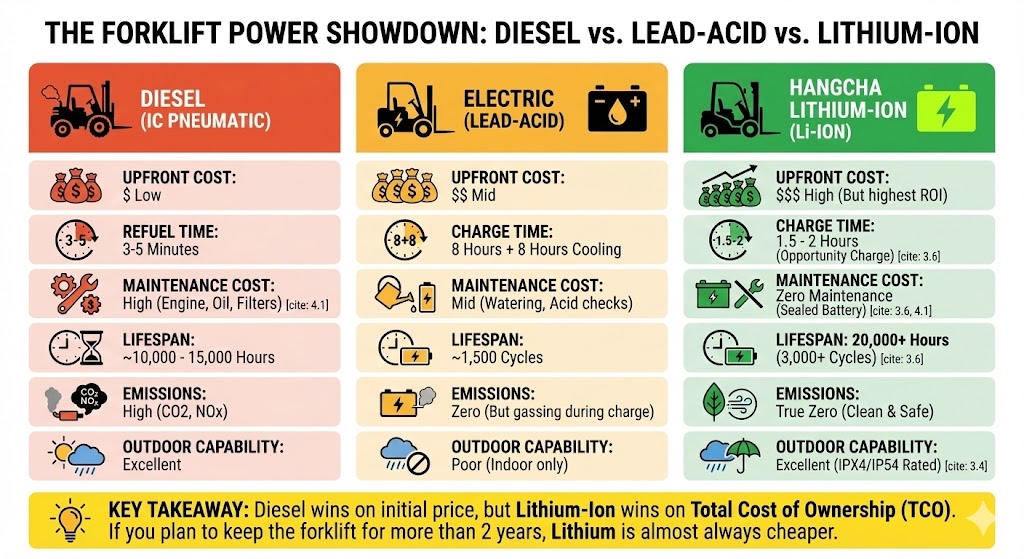
The Showdown: Diesel vs. Lead-Acid vs. Lithium-Ion
To make the right choice, you need to look beyond the sticker price. Most buyers make the mistake of comparing Diesel only to “Old Electric” (Lead-Acid).
Below is the true comparison including the modern standard: Lithium-Ion.
| Feature |
Diesel (IC Pneumatic) |
Electric (Lead-Acid) |
Hangcha Lithium-Ion (Li-Ion) |
| Upfront Cost |
$ Low |
$$ Mid |
$$$ High (But highest ROI) |
| Refuel / Charge Time |
3-5 Minutes |
8 Hours + 8 Hours Cooling |
1.5 - 2 Hours (Opportunity Charge) |
| Maintenance Cost |
High (Engine, Oil, Filters) |
Mid (Watering, Acid checks) |
Zero Maintenance (Sealed Battery) |
| Lifespan |
~10,000 - 15,000 Hours |
~1,500 Cycles |
20,000+ Hours (3,000+ Cycles) |
| Emissions |
High (CO2, NOx) |
Zero (But gassing during charge) |
True Zero (Clean & Safe) |
| Noise Level |
Loud (75-85 dB) |
Quiet |
Silent |
| Outdoor Capability |
Excellent |
Poor (Indoor only) |
Excellent (IPX4/IP54 Rated) |
Key Takeaway: Diesel wins on initial price, but Lithium-Ion wins on Total Cost of Ownership (TCO). If you plan to keep the forklift for more than 2 years, Lithium is almost always cheaper.
Top Forklift Brands to Watch (2025)
The market is crowded, but quality varies significantly. Here are the top players dominating the global market:
Top Electric & Lithium Innovators
- Hangcha (HC): A top 10 global manufacturer. Known for democratizing Lithium technology—offering premium High Voltage (XH, XE Series) performance at a competitive price point.
- Toyota / Raymond: The global sales leader. Excellent reliability but often comes with a premium price tag and longer lead times.
- Jungheinrich: A German engineering giant, particularly strong in narrow-aisle warehousing equipment.
- Crown: Known for ergonomic design and strong presence in the North American warehousing sector.
- BYD: An early adopter of lithium technology, focusing heavily on battery integration.
Top Diesel & Heavy-Duty Brands
- Caterpillar / Mitsubishi: Renowned for rugged durability in the toughest construction environments.
- Hyster-Yale: Famous for “Big Trucks” and container handlers used in ports and lumber yards.
- Toyota: Still a dominant force in the IC (Internal Combustion) market with engines known for longevity.
- Komatsu: Brings heavy earth-moving heritage to their forklift reliability.
- Hangcha: Yes, they make diesel too. Their X-Series diesel trucks are popular for blending ruggedness with modern ergonomics.
More forklift manufacturer list here.
Decision Guide: Which Forklift Fits Your Business?
Don’t just guess. Find your industry below to see the recommended power source.
1. Warehousing, Retail & Logistics
- Best Choice: Electric (Lithium-ion)
- Why: You need silence, zero emissions, and a tight turning radius. Diesel exhaust will trigger alarms and violate indoor air quality regulations. Lithium allows 24/7 operation with opportunity charging during shift changes.
2. Construction, Lumber & Brick Yards
- Best Choice: Diesel OR High-Voltage Lithium
- Why: Traditionally, this was Diesel territory due to rough terrain. However, High-Voltage Electric Forklifts (like Hangcha’s XH Series) now match diesel torque and water resistance.
- Choose Diesel if: You have absolutely no access to electricity for charging on remote sites.
- Choose High-Voltage Electric if: You want to save 75% on fuel costs and have a grid connection available.
3. Food & Beverage / Pharmaceuticals
- Best Choice: Electric (Mandatory)
- Why: Hygiene is non-negotiable. Diesel soot is a contamination risk. Lead-acid batteries are also risky due to potential acid spills. Lithium-ion is the only “clean room” safe option that offers high performance.
Maintenance & Safety: What to Expect
Diesel Maintenance (The “Dirty” Work)
Diesel trucks are needy. You must schedule downtime for:
- Engine Oil & Filter Changes: Every 250-500 hours.
- Cooling System Flushes: To prevent overheating in summer.
- Transmission Fluid: Regular checks to prevent slippage.
- Braking Systems: Heavier wear due to the weight of the engine.
Electric Maintenance (The “Easy” Life)
- Lead-Acid: Requires a dedicated “battery room” and weekly watering. If you forget to water them, the battery dies permanently.
- Lithium-Ion: Zero daily maintenance. The Battery Management System (BMS) balances the cells automatically. You only need to check tires and hydraulic fluid.
Safety Tip
- Diesel: The noise causes operator fatigue. Drivers need hearing protection.
- Electric: They are too quiet. You must install Blue Safety Lights and travel alarms to warn pedestrians that a truck is approaching.
Conclusion: The Future is Electric (But Diesel Has a Niche)
The battle between Electric and Diesel isn’t really a battle anymore—it’s a transition.
If you are buying a forklift in 2025:
- Buy Diesel only if you work in remote outdoor locations with zero electrical infrastructure.
- Buy Lithium-Ion for everything else. It offers the power of diesel, the clean operation of electric, and a lower total cost of ownership.
Ready to electrify your fleet?
Don’t let old myths about “weak” electric trucks hold your business back. Explore the Hangcha XH Series today and experience the power of High Voltage.
Frequently Asked Questions (FAQ)
Q: Can Hangcha electric forklifts really work in the rain?
A: Yes. Modern Hangcha electric forklifts, specifically the XE and XH Series, are built with IPX4 and IP54 water resistance. They are designed to operate outdoors in rain and on uneven surfaces, just like a diesel truck.
Q: How long does a lithium forklift battery last?
A: A Hangcha Lithium Iron Phosphate (LiFePO4) battery is designed to last over 4,000 charge cycles. In a typical single-shift operation, this battery can last 10+ years with zero daily maintenance.
Q: Is a lithium forklift more expensive than diesel?
A: The upfront purchase price is higher (typically 15-20% more). However, because you save money on fuel, oil changes, and engine maintenance, the Total Cost of Ownership (TCO) is usually lower for lithium after about 18-24 months of use.
Q: How long does it take to charge a Hangcha lithium forklift?
A: With fast charging, a Hangcha lithium forklift can reach a full charge in 1.5 to 2 hours. Many operators use “opportunity charging,” plugging the truck in for 15-30 minutes during breaks to keep it running through multiple shifts.


 عربى
عربى