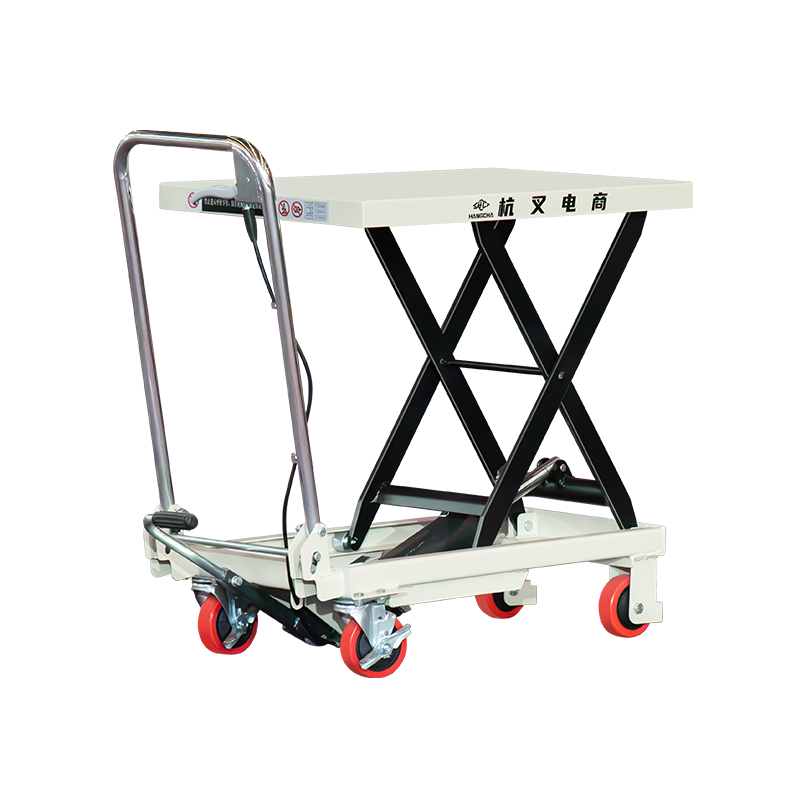
AGV vs. RGV: The Battle for Warehouse Efficiency
Flexibility or Speed? How to Choose the Right Material Handling System
Introduction
In the fast-paced world of modern logistics and manufacturing, the pressure to move materials faster, safer, and cheaper is relentless. As companies move away from manual labor, two dominant technologies have emerged to take the weight off human shoulders: Automated Guided Vehicles (AGVs) and Rail-Guided Vehicles (RGVs).
While both systems share the same goal—automating the movement of goods from Point A to Point B—they achieve it in fundamentally different ways. One offers the freedom of the open floor, while the other offers the unmatched speed of a dedicated track.
Choosing between them is not just about comparing specs; it is about understanding the “personality” of your facility. This article breaks down the technical differences, pros, and cons of AGVs and RGVs to help you decide which system is the right engine for your growth.
What are Automated Guided Vehicles (AGVs)?
Definition and Functionality
An Automated Guided Vehicle (AGV) is a portable robot that follows markers or wires in the floor, or uses vision, magnets, or lasers for navigation. They are effectively “driverless vehicles” that operate alongside humans and other equipment in a shared workspace.
Unlike conveyor belts or fixed cranes, AGVs are mobile and self-contained. They are the “taxis” of the factory floor, capable of adjusting their routes and tasks based on real-time software commands.
Types of AGVs
AGVs come in many shapes and sizes, depending on what they need to carry:
- Unit Load Carriers: Flat, platform-style robots that carry heavy loads (like engines or large pallets) directly on their “back.”
- Tow Tractors (Tuggers): Vehicles that pull a string of unpowered carts behind them, acting like a train.
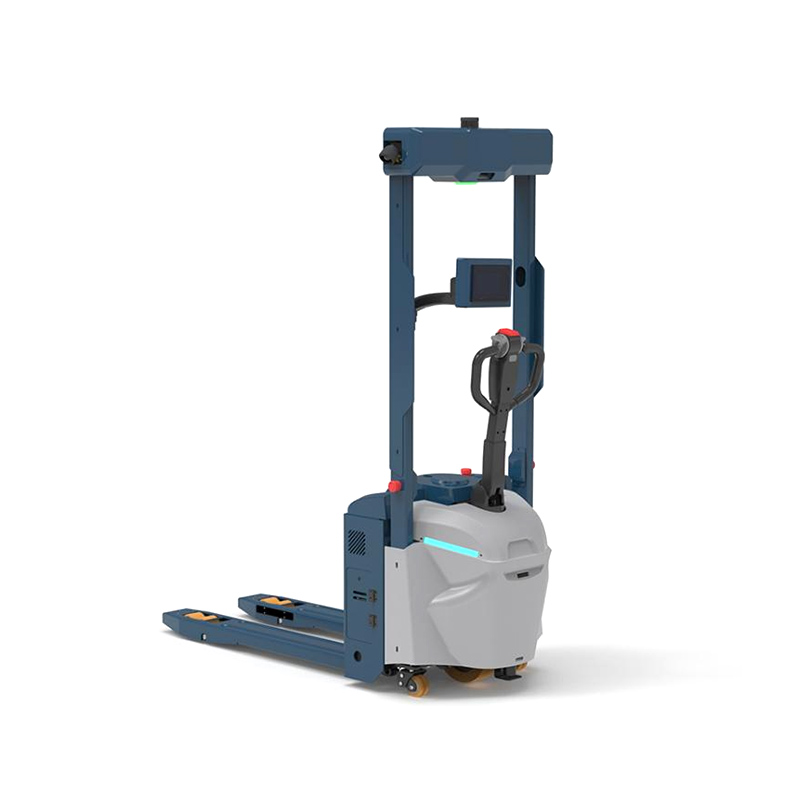
- Automated Forklifts (AGFs): Perhaps the most versatile type, these are standard forklifts equipped with robotic sensors. Major manufacturers like Hangcha have pioneered this space by converting robust manual forklift chassis into fully autonomous vehicles. This allows facilities to retain their existing racking capabilities while removing the need for a human driver.
Navigation Methods
How does an AGV know where to go?
- Wire/Magnetic Tape: The robot follows a physical line on the floor. Simple and reliable, but hard to change.
- Laser Navigation (LiDAR) & SLAM: The modern standard. The AGV uses rotating lasers to “see” walls and racking, building a virtual map. This is the technology used in advanced systems, such as Hangcha’s Intelligent Logistics fleet, allowing users to redraw paths in software without touching the facility floor.
- Vision Guided: Uses cameras to recognize the environment, similar to how a human sees.
Advantages of AGVs
- Flexibility: This is the AGV’s superpower. If your production line changes next year, you simply reprogram the map. You don’t need to rip up rails or conveyors.
- Scalability: Need to move more goods during peak season? You can simply rent or buy two more AGVs and add them to the fleet.
- Ease of Installation: Since they don’t require heavy infrastructure construction (like rails), installation is faster and less disruptive to daily operations.
Disadvantages of AGVs
- Lower Speed: For safety reasons, AGVs generally move slower (usually 1–2 meters/second) because they share the floor with humans.
- Battery Dependence: Unlike rail vehicles that can draw constant power, AGVs must charge. However, modern Lithium-ion solutions are mitigating this by allowing for fast “opportunity charging.”
- Floor Quality: AGVs need a relatively smooth, clean floor to operate efficiently.
What are Rail-Guided Vehicles (RGVs)?
Definition and Functionality
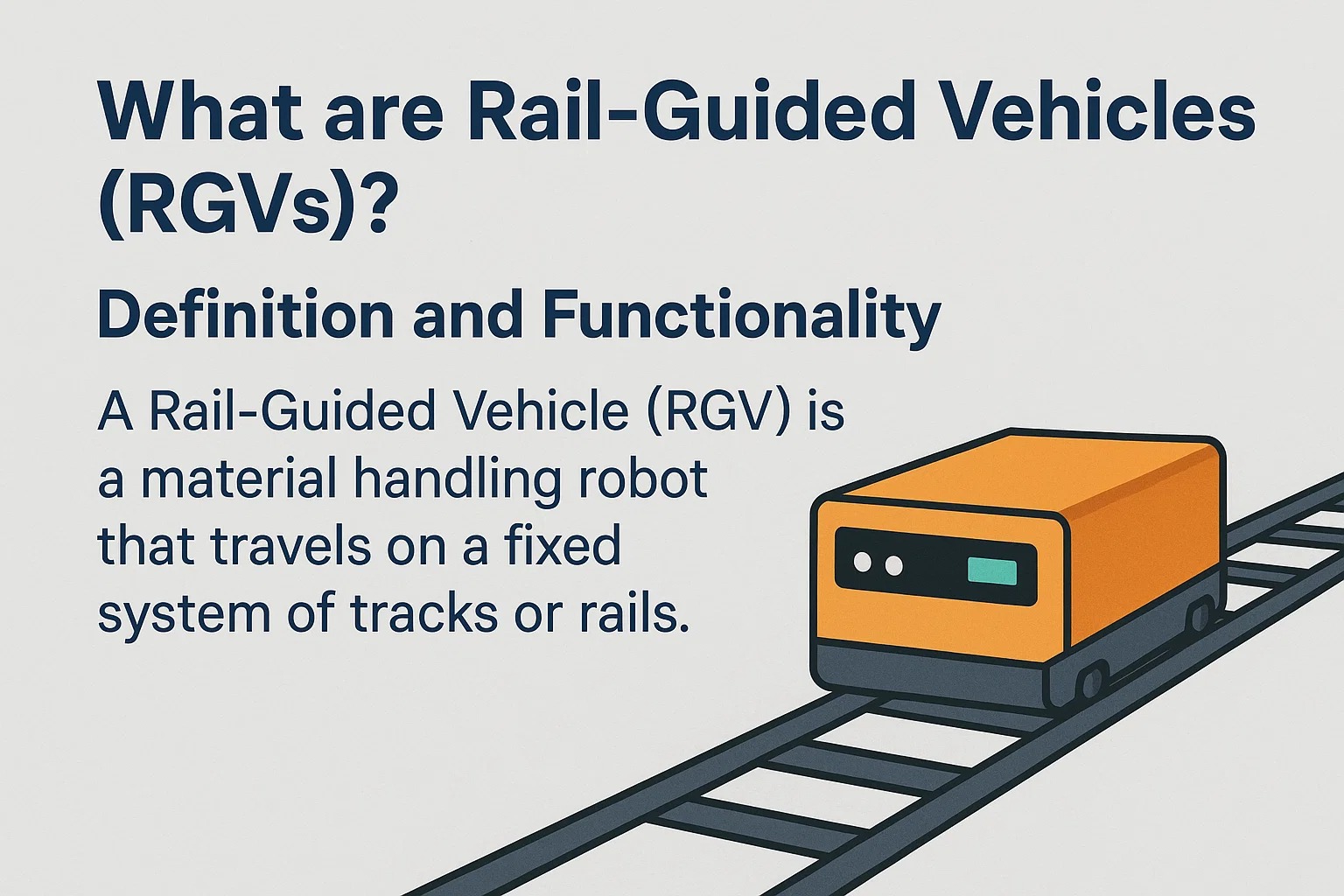
A Rail-Guided Vehicle (RGV) is a material handling robot that travels on a fixed system of tracks or rails. Unlike the free-roaming AGV, the RGV is physically tethered to its path. It moves forwards and backwards (and sometimes around curves) at high speeds, acting as a dedicated shuttle for materials.
RGVs are the “high-speed trains” of the warehouse. They are designed for simple, repetitive, high-throughput tasks where speed and reliability are more important than flexibility.
Types of RGVs
- Linear Shuttles: These move back and forth on a straight track, often used to feed pallets into an Automated Storage and Retrieval System (AS/RS).
- Loop RGVs / Sorting Transfer Vehicles (STV): These travel in a circular loop, capable of sorting loads to different stations at high speeds.
- Assembly Line Carriers: Heavy-duty platforms that move large products (like car chassis) from one assembly station to the next along a fixed production line.
Advantages of RGVs
- Speed and Throughput: Because they run on dedicated rails and don’t have to navigate around humans, RGVs are significantly faster than AGVs. They can often travel at speeds of 3–5 meters/second (compared to 1–2 m/s for AGVs).
- Continuous Power (No Charging): This is a critical advantage. Most RGVs draw power directly from a sliding contact line (busbar) inside the rail. They can operate 24/7 without ever stopping to charge batteries.
- Heavy Load Stability: The physical rails provide a solid foundation, making RGVs excellent for moving extremely heavy loads (such as steel coils or heavy machinery) that might be unstable on a free-roaming vehicle.
Disadvantages of RGVs
- The “Barrier Effect”: The rails are permanent fixtures. They effectively cut the floor in half, preventing forklifts or people from crossing easily.
- Zero Flexibility: Changing an RGV’s path requires construction work—ripping up rails and laying new ones.
- Space Requirements: Because RGVs move so fast, they usually require safety fencing around the entire track, which consumes valuable floor space.
Key Differences Between AGVs and RGVs
When choosing between an AGV and an RGV, you are essentially choosing between Flexibility and Speed. The table below highlights the critical technical differences.
| Feature |
AGV (e.g., Hangcha AGF) |
RGV (Rail-Guided) |
| Navigation |
Flexible (Laser/Vision/SLAM). Can change paths via software. |
Fixed (Physical Rails). Path is permanent unless reconstructed. |
| Power Source |
Battery. Requires charging (Li-ion opportunity charging). |
Busbar / Sliding Line. Continuous power, no downtime for charging. |
| Speed |
Moderate (1-2 m/s). Safety limited for mixed traffic. |
High (3-5+ m/s). Designed for rapid throughput. |
| Floor Impact |
Low. Shares floor with humans/forklifts. Virtual paths. |
High. Rails create physical barriers; often requires fencing. |
| Installation |
Fast. Minimal infrastructure changes needed. |
Complex. Requires laying tracks and electrical lines. |
| Scalability |
Easy. Just buy another vehicle to increase capacity. |
Hard. Requires extending rails or adding complex loop controls. |
| Best Use Case |
Complex networks, changing layouts, rack stacking. |
High-speed transport between two fixed points (A to B). |
The “Flexibility vs. Throughput” Trade-off
The decision often comes down to a simple question: Do you need to go everywhere, or do you need to go somewhere fast?
- Choose AGVs (like the Hangcha forklift series) if your priority is versatility. If you need to pick up pallets from varying locations, stack them into racks, and adapt to future layout changes, the AGV is the superior choice.
- Choose RGVs if your priority is raw volume. If you need to move 500 pallets per hour from a production line to a warehouse on a straight line, the RGV’s speed and non-stop power supply make it the winner.
Applications: Where They Shine
Applications of AGVs
AGVs excel in environments where adaptability is key. They are the preferred choice for facilities that operate with mixed traffic or need to change workflows frequently.
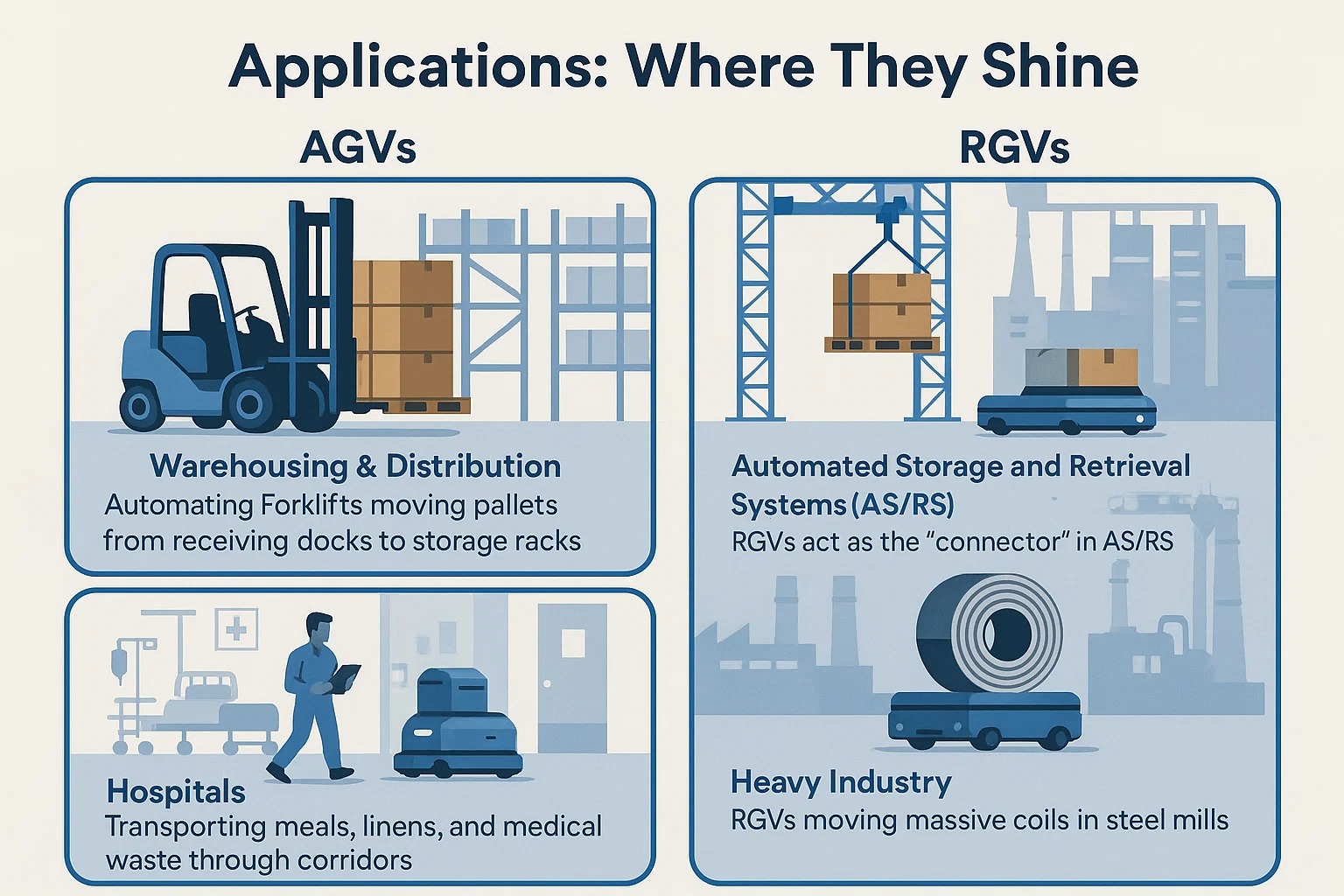
- Warehousing & Distribution: Moving pallets from receiving docks to storage racks. Automated Forklifts (like those from Hangcha) are particularly dominant here because they can lift vertically, unlike standard floor robots.
- Flexible Manufacturing: delivering raw materials to assembly stations on a “Just-In-Time” (JIT) basis.
- Hospitals: Transporting meals, linens, and medical waste through corridors shared with staff and patients.
- End-of-Line Automation: Collecting finished goods from packaging lines and transporting them to the shipping area.
Applications of RGVs
RGVs dominate in environments requiring high-speed, repetitive transport over fixed distances.
- Automated Storage and Retrieval Systems (AS/RS): This is the #1 use case for RGVs. They act as the “connector,” racing back and forth to collect pallets from high-bay cranes and delivering them to picking stations.
- Heavy Industry: Steel mills and paper plants use RGVs to move massive coils (weighing 10+ tons) that would be too heavy or dangerous for free-roaming AGVs.
- Automated Assembly Lines: In automotive plants, RGVs often carry the car chassis from station to station, providing a perfectly stable platform for robots to weld or paint.
Choosing the Right System: 5 Factors to Consider
If you are still on the fence, evaluate your facility against these five criteria.
1. Path Complexity & Flexibility
- Dynamic: If your routes change seasonally, or if you need to navigate a complex network of aisles, AGVs are the clear winner. You can update their map in software instantly.
- Fixed: If you are moving material from Point A to Point B on a straight line for the next 10 years, an RGV is more efficient.
2. Throughput & Speed
- High Volume: Do you need to move 500 pallets an hour? The 3–5 m/s speed of an RGV is necessary.
- Standard Volume: For standard warehouse operations, the 1–2 m/s speed of an AGV is sufficient and safer for mixed environments.
3. Space Constraints
- Tight Spaces: AGVs are better for tight layouts. They don’t require fences and can share aisles with humans.
- Dedicated Zones: RGVs require a “no-go zone.” You need enough floor space to install the track and the safety fencing around it.
4. Implementation Time
- Quick Start: AGVs are “plug-and-play.” You can deploy a Hangcha forklift AGV relatively quickly because it runs on your existing floor.
- Construction Project: RGVs are a construction project. You must plan for floor leveling, rail installation, and electrical integration, which takes months.
5. Maintenance & Power
- Battery Mgmt: With AGVs, you must plan for battery charging strategies (even with fast Li-ion charging).
- Set & Forget: RGVs have simpler mechanics and continuous power, often leading to lower maintenance requirements over long periods.
Conclusion
The choice between an Automated Guided Vehicle (AGV) and a Rail-Guided Vehicle (RGV) is not about which technology is “better”—it is about which technology fits your specific operational DNA.
- Choose the RGV if you need a high-speed, heavy-duty “train” to move massive volumes of goods on a permanent, fixed route.
- Choose the AGV if you need a flexible, intelligent “taxi” that can navigate complex layouts, work alongside your team, and adapt to tomorrow’s changes.
For many modern warehouses, the AGV (and specifically the Automated Forklift) is becoming the default choice because it offers the path of least resistance: it automates the job without redesigning the building. However, for the backbone of a high-speed automated factory, the RGV remains the undisputed king of throughput.
Real-World Case Studies
To understand the practical application of these technologies, let’s look at two hypothetical scenarios based on common industry projects.
Case Study A: The E-Commerce Distribution Center (AGV Win)
The Challenge: A rapidly growing 3PL (Third-Party Logistics) provider faced a common problem: labor shortages and high seasonality. During “Black Friday” peaks, they needed to double their throughput, and their warehouse layout changed every 6 months to accommodate new products.
The Solution: The company replaced their fleet of manual reach trucks with Automated Guided Forklifts (AGFs), such as the Hangcha Intelligent Logistics series.
Why AGV Won:
- No Infrastructure Changes: Because the facility was leased, they could not drill into the floor to install RGV rails.
- Scalability: During peak season, they simply rented additional units to join the fleet.
- Result: They achieved 24/7 operation with zero overtime costs and reduced product damage by 40% due to the precise navigation of the sensors.
Case Study B: The Beverage Bottling Plant (RGV Win)
The Challenge: A soft drink manufacturer needed to move finished pallets from the bottling line to the warehouse. The distance was fixed (200 meters), but the volume was massive: 300 pallets per hour, non-stop, 24 hours a day.
The Solution: They installed a high-speed Loop RGV System with multiple shuttles running on a dedicated track.
Why RGV Won:
- Speed: AGVs would have been too slow (1.5 m/s) to keep up with the bottling line. The RGVs ran at 4 m/s.
- Power: With a busbar power system, the RGVs never had to stop for charging, preventing bottlenecks at the production line output.
- Result: The system cleared the production line output instantly, preventing any stoppages in the bottling process.
Future Trends: The Hybrid Approach
As automation technology matures, the strict line between AGVs and RGVs is blurring. Many advanced “Smart Factories” are now deploying Hybrid Systems.
In this model, the RGV acts as the “Highway,” moving goods rapidly over long distances between major zones. Once the RGV reaches the destination, it hands the load off to an AGV, which acts as the “Taxi,” taking the goods the “last mile” to a specific rack or workstation.
By combining the speed of rails with the flexibility of mobile robots, companies can achieve the best of both worlds.
Frequently Asked Questions (FAQ)
1. Which is cheaper: AGV or RGV?
Generally, AGVs have a lower initial cost because they do not require expensive construction work (like laying rails). However, RGVs can sometimes be cheaper to maintain in the long run because they have simpler mechanics and do not require battery replacements.
2. Do I need to stop operations to install an AGV system?
Usually, no. This is a major benefit of AGVs. Because they run on the existing floor, you can map the facility and deploy the robots over a weekend or during a slow shift. Installing an RGV system typically requires shutting down a section of the facility for construction to lay the tracks.
3. How long do AGV batteries last?
It depends on the technology. Older lead-acid batteries required 8 hours to charge. Modern Lithium-ion batteries (like those used in Hangcha’s automated forklifts) can last for many years and support “opportunity charging,” meaning they can run 24/7 with short charging bursts during breaks.
4. Are AGVs safe to work alongside humans?
Yes. AGVs are equipped with comprehensive safety systems, including LiDAR sensors and bumpers. If a human steps in front of an AGV, it will detect the obstacle and stop immediately. RGVs, however, are usually fenced off because they move too fast to stop safely for humans.
5. Can a standard forklift be converted into an AGV?
Yes! This is exactly what an AGF (Automated Guided Forklift) is. Manufacturers take a standard manual forklift chassis and retrofit it with automation kits. This provides the durability of a proven vehicle with the intelligence of a robot.
6. Can AGVs work outside?
Most standard AGVs are designed for indoor use on smooth floors. However, specialized outdoor AGVs exist (often based on heavy-duty tow tractors or counterbalanced forklifts) that use GPS navigation, but these are more expensive than indoor models.


 عربى
عربى