In the fast-paced world of intralogistics, “Automation” isn’t just a buzzword—it’s a survival strategy. As businesses rush to optimize their warehouses, the demand for Automated Guided Vehicles (AGVs) and Autonomous Mobile Robots (AMRs) has skyrocketed.
However, for many facility managers and procurement officers, the path to automation hits a roadblock right at the start: Navigation Technology.
You scan the datasheets and see terms like “Laser Guidance,” “Reflectors,” “SLAM,” and “LiDAR.” Which one is right for your facility? Do you need to install reflectors on every wall, or can the forklift “see” for itself?
At Hangcha Group, we believe that the best technology is the one that makes your job easier, not harder. In this article, we will break down the critical differences between traditional Laser Guidance and the modern SLAM (Simultaneous Localization and Mapping) technology, helping you decide which fits your warehouse environment.
Before we dive into the technical comparison, let’s look at what the future of navigation looks like.
In the past, deploying an AGV meant weeks of “commissioning”—installing reflective strips, modifying your facility, and training the software. But technology has evolved.
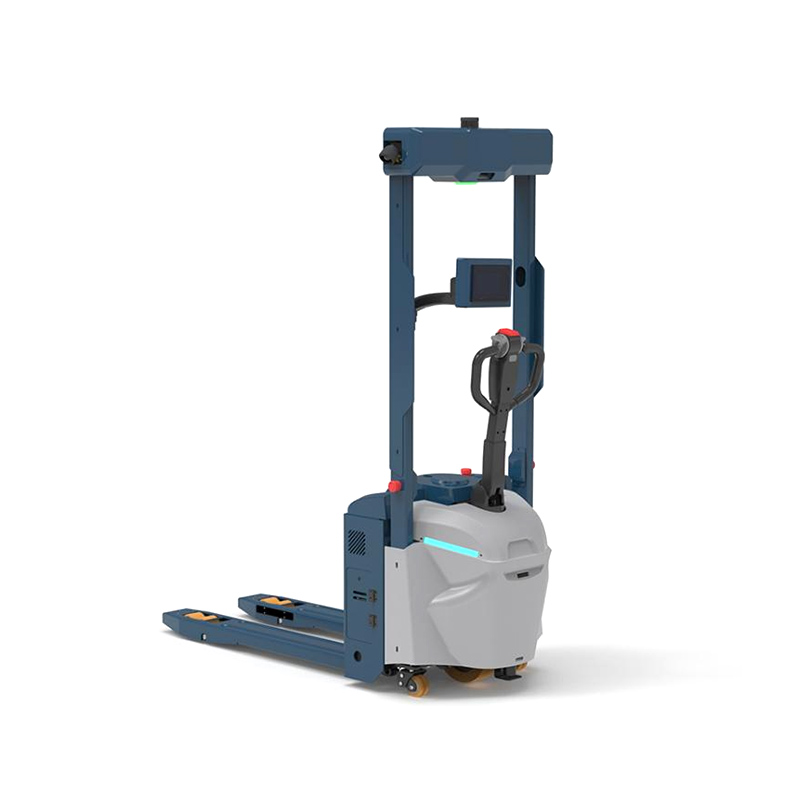
Take the newly launched Hangcha 2 Tons Forklift AGV Ez-Go Series as a prime example of this shift. It redefines the standard for industrial logistics by moving away from complex infrastructure.
Meet the Ez-Go: The “Plug-and-Play” Solution
The Ez-Go isn’t just an automated pallet truck; it is a testament to how 3D LiDAR (SLAM) technology overturns the complex deployment model of traditional AGVs.
With a futuristic “Bull-inspired” design and a 2000kg rated capacity, the Ez-Go proves that modern AGV navigation is about being fast, flexible, and powerful.
But how does this “No Reflector” technology actually compare to the traditional methods? Let’s dive deep into the differences.
To understand why the Ez-Go is a game-changer, we first need to understand what it is replacing. Let’s look at the two dominant players in AGV navigation.
For decades, this has been the industry standard for AGVs (often called LGVs or Laser Guided Vehicles).
This is the technology that powers the Hangcha Ez-Go series. It represents the shift from “Guided Vehicles” to true “Autonomous Mobile Robots” (AMRs).
Which system offers the best ROI for your business? Let’s compare the traditional method against the modern SLAM capabilities found in the Ez-Go.
| Feature | Traditional Laser Guidance (Reflectors) | SLAM / Natural Navigation (Hangcha Ez-Go) |
|---|---|---|
| Infrastructure Setup | High Effort. Requires installing hundreds of reflective strips on walls and racks. | Zero Effort. “Plug-and-play.” Uses existing walls and racks as reference points. |
| Deployment Time | Weeks. Installation + commissioning + testing. | Hours. As noted with Ez-Go, “only half a day of training” and rapid deployment. |
| Flexibility | Low. Changing routes requires moving reflectors and re-surveying the site. | High. Dynamic path planning. Map updates can be done via software instantly. |
| Maintenance | Ongoing. Reflectors get dirty, damaged, or blocked, causing the AGV to stop. | Low. No external hardware to maintain. The 3D Laser is self-contained. |
| Accuracy | Extremely High (±5mm). Ideal for high-bay stacking (10m+). | Precision (±15mm). The Ez-Go achieves ±15mm, which is perfect for standard pallet handling and stacking. |
| Environment | Static. Best for warehouses that never change layout. | Dynamic. The Ez-Go’s multi-sensor fusion adapts to changing environments and bypasses obstacles. |
You might notice the Ez-Go is listed as having a “3D Laser Navigation System.” This is an advanced form of SLAM.
It is important to clear up a common misconception. When we say the Hangcha Ez-Go uses “3D Laser Navigation,” we are not talking about the old-fashioned method of bouncing beams off wall reflectors.
The Ez-Go uses LiDAR (Laser Imaging, Detection, and Ranging) sensors as its “eyes,” but the “brain” behind it is SLAM technology.
The Verdict: If you see “No on-site modifications required” on a datasheet, you are looking at advanced SLAM technology. This is the future of material handling.
To help you make the final decision for your fleet, here is our expert recommendation:
Stick to Traditional Reflector Guidance IF:
Choose Hangcha Ez-Go (SLAM) IF:
The era of complex, rigid, and expensive AGV projects is ending. With the Ez-Go 2 Tons Forklift AGV, Hangcha is proving that industrial automation can be as simple as “Plug-and-Play.”
Whether you are looking to automate a single pallet transfer route or build a fully interconnected smart factory with Intelligent Traffic Management, the technology is now accessible, scalable, and easier than ever to deploy.
Don’t let the fear of complex installation hold you back. With 3D SLAM navigation, your warehouse doesn’t need to change—your forklifts just need to get smarter.
Ready to transform your logistics?
Discover how the Hangcha Ez-Go Series can drive efficiency in your warehouse without the hassle of infrastructure modifications.

+86-0571-88131206

+86-19084200370

+86-17816721301
 عربى
عربى