The Real-World Shift: Forklift AGVs Beyond the Hype
Walk onto a modern warehouse floor and you’ll notice something strange: it’s quiet. The frantic revving of manual forklifts is being replaced by the hum of Forklift AGVs. These aren’t just “robots”; they are heavy-duty machines that finally have the “eyes” to navigate the chaos of a 24/7 supply chain.
We’ve moved past the era of magnetic tape. Today’s top-tier AGVs use SLAM (Natural Navigation). Think of it as the machine constantly whispering to its surroundings with LiDAR pulses, building a live 3D map. It doesn’t just follow a path; it perceives a stray box or a walking colleague and adjusts in milliseconds. When you link this to a Warehouse Management System (WMS), the forklift stops being a tool and starts being a node in a self-correcting network.
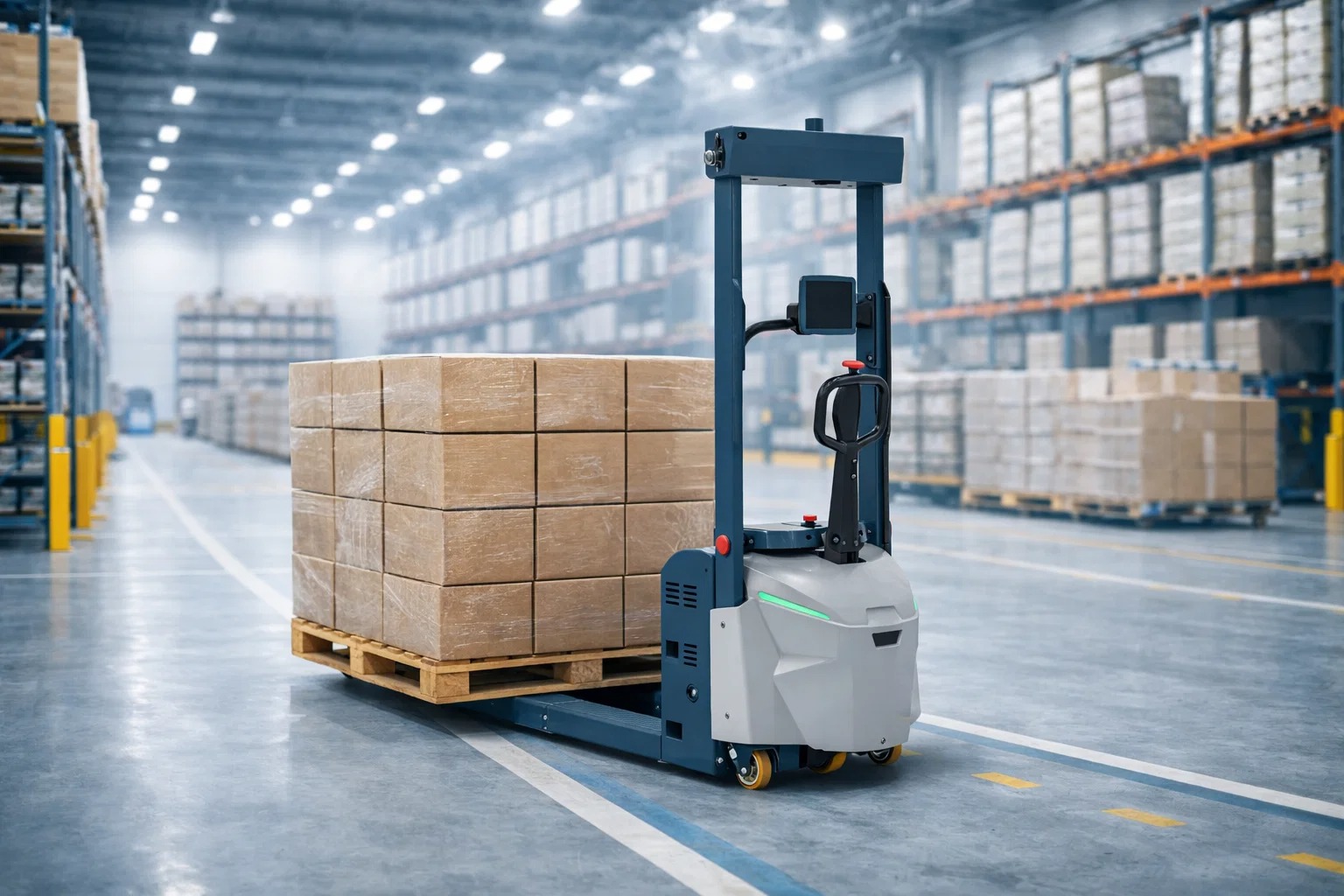
Real talk: the biggest saving isn’t just headcount—it’s predictability. Humans get tired at 3:00 AM; machines don’t. An AGV won’t clip a rack, drop a pallet, or drive through a dock door because of a momentary distraction. By slashing product damage and maintenance costs, the ROI often hits much faster than you’d expect. Plus, you’re finally free from the endless cycle of hiring and training drivers in a high-turnover market.
They are a godsend for Cold Storage—honestly, why send a human into a -20°F freezer if you don’t have to? They are equally vital in Pharma for their surgical precision.
But a word of caution: AGVs aren’t “plug-and-play.” If your floors are uneven, your Wi-Fi is spotty, or your pallets are a collection of broken wood, these machines will struggle. They demand a standardized environment to deliver that “Swiss watch” efficiency.
Is it time to pull the trigger? If your moves are repeatable and your volume is high, it’s likely a “when,” not an “if.” Manufacturers like Hangcha, Toyota, and Linde are making the entry barrier lower every year. It’s a shift from managing people to managing systems—a learning curve, sure, but the peace of mind of a perfectly predictable floor is hard to beat.
Let’s be honest: nobody actually wants to work in a -20°C freezer. It’s a brutal environment where human productivity drops as fast as the temperature. You’ve got the “warm-up” breaks, the bulky gear that slows down every movement, and the constant safety risks of slippery floors.
This is where Forklift AGVs stop being a luxury and start being a necessity. Unlike us, a machine doesn’t care about the chill—provided it’s built for it.
You can’t just take a standard AGV and throw it into a freezer; it would be dead in an hour. The real magic happens with automated climate control inside the machine itself.
If you’re shopping for a fleet, you’ll find that the “best” brand depends entirely on whether you value legacy iron or cutting-edge software. Here is how the big players stack up right now:
| Manufacturer | Core Specialty | Tech Edge | Best For… |
|---|---|---|---|
| Hangcha | High-Value Integration | Rapid SLAM Deployment | High-volume sites needing fast ROI. |
| Toyota (T-AB) | Global Support Legacy | Rock-solid Hardware | Companies prioritizing long-term parts & service. |
| Linde (KION) | Precision Engineering | Advanced Safety Sensors | Complex layouts with high pedestrian traffic. |
| Jungheinrich | System Synergy | Deep WMS Integration | Fully automated “lights-out” warehouses. |
If you’re running a standard ambient warehouse, your choice of manufacturer might come down to price and local support. But for specialized environments like cold storage or pharma, don’t cut corners.
A cheaper AGV that loses its “vision” every time a cloud of frost hits its sensors isn’t an investment—it’s a headache. I’ve seen operations grind to a halt because they saved 10% on the hardware but spent 50% more on downtime repairs. The goal isn’t just to automate; it’s to automate so well that you forget the machines are even there.
Before you sign the check for a fleet of AGVs, let’s have a “coffee-table” chat. I’ve seen too many managers fall in love with the brochure, only to realize their warehouse floor is the AGV equivalent of an obstacle course. If your facility isn’t ready, these machines won’t be “efficient”—they’ll just be expensive paperweights.
Here is the “No-BS” checklist to see if you’re actually ready for the rollout.
AGVs crave consistency. If your pallets are a mix of high-quality plastic and broken, splintering wood, you’re going to have a bad time.
An AGV is only as smart as its connection. If your warehouse has “dead zones” behind the racking or near the loading docks, the AGV will literally lose its mind.
You might think your floor is flat, but an AGV with a 2-ton load at full lift height will tell you otherwise.
If you’ve checked the boxes above, don’t try to automate everything overnight. That’s how projects fail. Instead, follow this path:
Start with the most boring, repetitive long-distance haul you have. Think: Moving finished goods from the end of the production line to the staging area. It’s a straight shot, low complexity, and high visibility.
Deploy 2 or 3 units. This isn’t about throughput yet; it’s about integration. Do they talk to your WMS correctly? Do your human drivers know how to work around them without getting frustrated?
Once the “handshakes” between the software and the hardware are smooth, that’s when you scale. This is where you start seeing those 24/7 gains and the ROI actually begins to compound.
The “Perfect Warehouse” doesn’t exist, but a prepared one does. Forklift AGVs are no longer just for the Teslas and Amazons of the world. With manufacturers like Hangcha and Linde making the tech more accessible, the barrier to entry has never been lower.
Just remember: you aren’t just buying a forklift; you’re upgrading your operating system. Respect the prep work, and the machines will handle the rest.
It’s one thing to look at a spec sheet; it’s another to see these machines survive a Tuesday morning rush. I recently looked into a mid-sized beverage distributor that was struggling with a 30% annual staff turnover and a mounting bill for “rack rash” (those nasty dents manual drivers leave on the shelving).
They didn’t automate the whole building. Instead, they started with their most dangerous and repetitive task: loading the heavy pallets onto the stretch-wrapper.
Within six months, their “accidental damage” costs dropped by nearly 85%. But the real surprise wasn’t just the safety. It was the flow. Because the AGVs moved with the rhythmic precision of a heartbeat, the stretch-wrapper never sat idle, and the staging area never got congested. They didn’t fire their drivers; they promoted them to “Fleet Leads,” overseeing the robots and handling the “weird” non-standard loads that require a human touch.
Even the best systems have bad days. If your AGV is acting like a stubborn toddler, it’s usually one of these three culprits:
The “Ghost” Obstacle: The AGV keeps stopping for no reason.
The Fix: Dust. In a warehouse, dust is inevitable. If a layer of grime coats the LiDAR lens, the “brain” thinks there’s a wall in front of it. A simple microfiber wipe-down usually does the trick.
The “I’m Lost” Syndrome: The machine stops and asks for a manual reset because it can’t find its location.
The Fix: Look at your environment. Did someone park a massive stack of empty crates in front of a key “landmark” the robot uses for navigation? In SLAM-based systems, if the room looks 40% different than the map, the robot gets confused. Keep your main aisles clear.
The Battery Blues: The AGV is constantly heading back to the charging station and not doing enough work.
The Fix: Check your “Opportunity Charging” settings. Modern Lithium AGVs are designed to “sip” power during 5-minute breaks. If your software isn’t tellling them to charge during downtime, they’ll run dry during the peak hours.
We used to talk about “The Warehouse of the Future” as if it were a sci-fi movie. But standing on a quiet floor, watching a Hangcha or a Toyota AGV glide past with two tons of product—guided by nothing but light and math—you realize the future is already on its third shift.
Whether you’re looking to solve a labor shortage, cut down on expensive accidents, or just bring some sanity to a chaotic floor, Forklift AGVs are the most pragmatic leap you can take. It’s not about replacing humans; it’s about giving humans a better, safer, and more predictable system to work within.
The question isn’t whether AGVs work—it’s whether your warehouse is ready to let them.
If you’ve got one AGV, it’s a high-tech helper. If you’ve got ten, you’ve got a traffic jam waiting to happen—unless you have a solid Fleet Management System (FMS).
Think of the FMS as the air traffic controller of your warehouse. It’s the “invisible hand” that prevents two 4,000-pound machines from having a standoff in a narrow aisle. It’s not just about avoiding crashes; it’s about optimization. The system looks at the entire floor and decides which robot is closest to a new task, which one needs to “pit stop” for a quick charge, and which route is currently congested.
In the industry, we’re seeing a shift toward “Swarm Intelligence.” Instead of a central “brain” barking orders, the AGVs are starting to talk to each other directly. If one robot hits a spill on the floor, it tells the others to take the long way around before the manager even knows there’s a problem. That’s the kind of “set it and forget it” efficiency that makes the high initial cost worth every penny.
One of the biggest shifts you’ll face when moving to AGVs is how you treat your equipment. With a manual forklift, you wait for a weird noise or a leak, then call the mechanic. With an AGV, that approach is a recipe for a shutdown.
The beauty of these machines is that they are essentially giant sensors. They track their own motor temperature, battery health, and sensor alignment in real-time.
What does the next decade look like? We’re already seeing the influence of 5G. In a massive warehouse, 5G allows for thousands of devices to connect without the latency “hiccups” of traditional Wi-Fi. This means AGVs can move faster and more confidently because their connection to the “brain” is instantaneous.
Then there’s AI-driven perception. Current AGVs are great at spotting a person, but they don’t always know what that person is doing. The next generation will be able to distinguish between a stationary pallet and a worker who looks like they’re about to step into the aisle, adjusting their speed proactively. We’re moving from “automatic” (following rules) to “autonomous” (making decisions).
Let’s wrap this up. Forklift AGVs aren’t just a fancy way to move boxes. They are a statement that your operation is ready to compete in a world where “fast” isn’t fast enough anymore.
Yes, the transition is a bit of a climb. You’ll need to fix your floors, upgrade your Wi-Fi, and change your maintenance habits. But once that system is humming at 2:00 AM on a Sunday—moving product with zero drama, zero damage, and zero overhead—you’ll wonder how you ever ran a warehouse without it.
Even after seeing the tech and the ROI, most people have a few “yeah, but…” questions. Let’s address the ones that usually come up over coffee after the formal presentation is over.
1. “Will these things actually run over my staff?”
In a word: No. In fact, they are significantly safer than manual forklifts. While a human driver might be distracted by a phone or fatigue, an AGV is packed with LiDAR and safety sensors that create a “protection bubble.” If anything—a person, a rogue pallet, or even a stray cat—breaks that field, the machine pulls an emergency stop instantly. They don’t get tired, and they don’t take “calculated risks.”
2. “Our warehouse is a bit… chaotic. Can an AGV handle a mess?”
Technically, yes, but you won’t like the result. If your aisles are constantly blocked by “temporary” clutter, the AGV will do exactly what it’s programmed to do: stop and wait for a clear path. To get your money’s worth, you have to shift from a “organized chaos” mindset to a “standardized flow.” If you can’t keep your aisles clear, you’re buying a very expensive stationary statue.
3. “How long does it take to actually get these things moving?”
It’s not an overnight switch. Typically, from the moment the machines arrive to the moment they are fully integrated into your WMS, you’re looking at 4 to 12 weeks. This includes mapping the environment, setting up the “traffic rules,” and the “handshake” period where the robots learn to talk to your inventory software.
4. “What happens if the Wi-Fi goes down?”
The short answer? Everything stops. AGVs are essentially “remote brains.” If they lose their connection to the Fleet Management System, they will safely come to a halt and wait for the signal to return. This is why we always emphasize that a “robot-ready” warehouse is, first and foremost, a “solid-network” warehouse.
5. “Can they work outside or on ramps?”
Most standard Forklift AGVs are “indoor cats.” Rain, snow, and uneven gravel can mess with their sensors and traction. As for ramps, they can handle them, but it drastically changes their battery consumption and speed. If you have steep inclines, you’ll need a model specifically rated for high-torque climbs.
6. “Are they going to be obsolete in three years?”
The hardware (the steel, the motors, the hydraulics) will last a decade or more. The software is what evolves. Most modern manufacturers like Hangcha or Linde push “Over-the-Air” updates, much like a Tesla. Your forklift might actually get smarter and more efficient two years after you bought it.
7. “Is it better to lease or buy?”
Because the technology is moving fast, many companies are opting for RaaS (Robots as a Service) or specialized leasing. This lets you upgrade to the “next gen” sensors in a few years without being stuck with “vintage” tech. However, if you have a stable, long-term operation, buying outright usually offers the best total ROI over a 5-year span.

+86-0571-88131206

+86-19084200370

+86-17816721301
 عربى
عربى