Part 1: Industry Insights & The Upgraded Definition of AGVs
1.1 The 2026 Manufacturing Context: From “Option” to “Core Strategy”
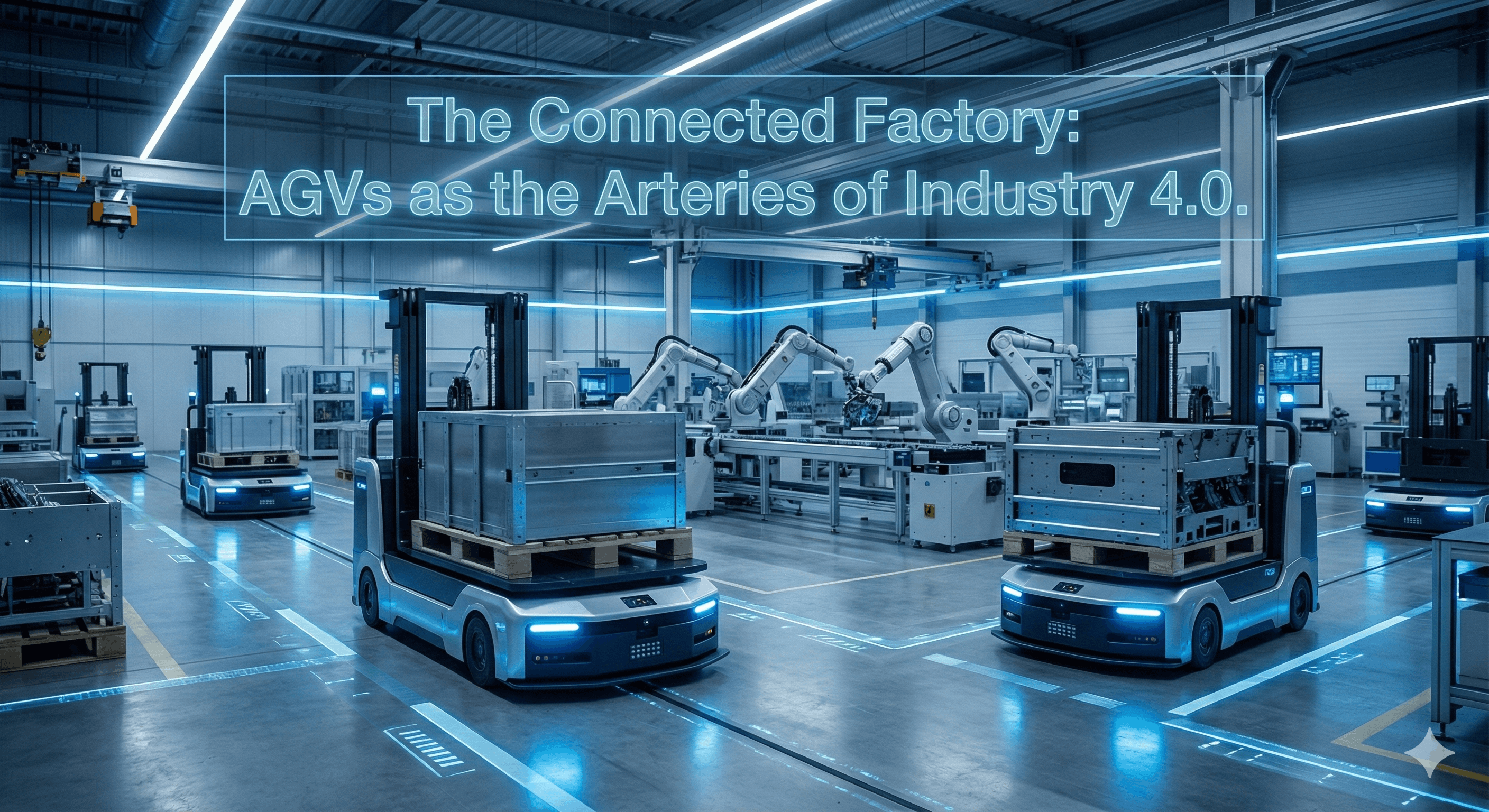
As we move through 2026, the global manufacturing sector has reached a critical inflection point. The conversation has shifted from the mere acquisition of hardware to the strategic integration of Autonomous Systems. Driven by persistent skilled labor shortages and the demand for “lights-out” manufacturing capabilities, Automated Guided Vehicles (AGVs) have evolved.
They are no longer viewed simply as “driverless forklifts” but as mobile IoT nodes that provide the physical link in a fully digitized production ecosystem. In 2026, a successful AGV deployment is measured not just by pallet moves per hour, but by its contribution to operational resilience and data-driven decision-making.
1.2 Redefining the AGV: More Than Just a Transporter
In the current industrial landscape, we define an AGV as a computer-controlled, wheel-based load carrier that operates without an onboard operator. However, the 2026 definition extends further:
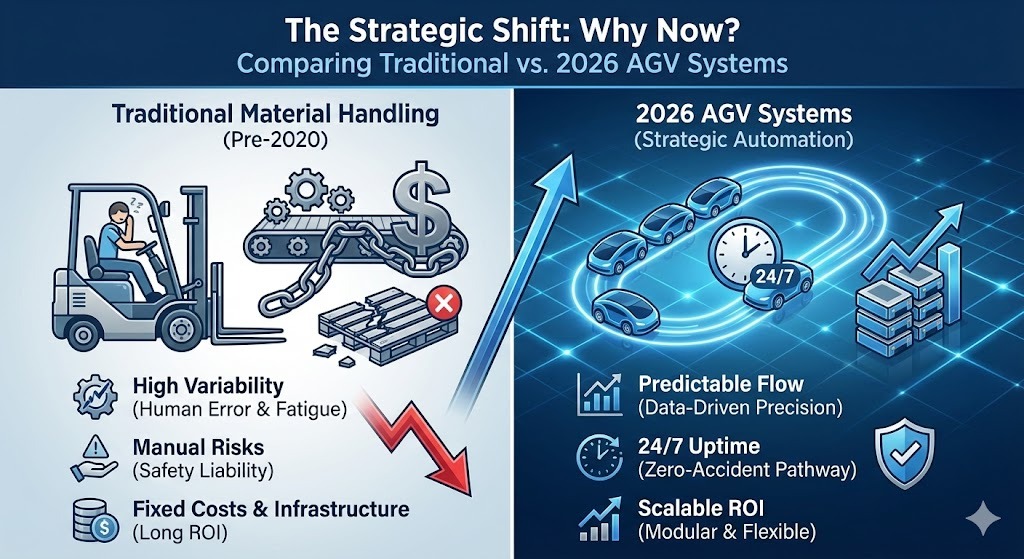
- Strategic Assets: AGVs are now critical tools for reducing Total Cost of Ownership (TCO) by eliminating the volatility of manual labor costs and the high frequency of human-error-related accidents.
- Predictable Precision: Unlike manual transport, AGVs offer a “deterministic” flow of goods. In a Just-In-Time (JIT) environment, they ensure that the right part arrives at the line-side at the exact millisecond required, minimizing Work-In-Process (WIP) inventory.
- Safety Paradigms: Beyond simple obstacle detection, modern AGVs utilize multi-modal sensor fusion (LiDAR, 3D Cameras, and Ultrasonic) to guarantee 360-degree safety, allowing for seamless human-machine collaboration in high-traffic zones.
1.3 The Strategic Shift: Why Now?
Why has AGV adoption accelerated so sharply in the mid-2020s?
- Labor Arbitrage is Dead: With rising wages globally, the ROI for automation has shortened from 3-5 years to 18-24 months in most developed industrial hubs.
- Scalability: Modern AGV fleets are modular. Manufacturers in 2026 can start with two units and scale to 200 as production volume grows, without the need for fixed infrastructure like conveyor belts.
- Safety Compliance: Stricter occupational health and safety regulations have made manual forklift operation a high-liability activity. AGVs provide a “Zero-Accident” pathway for material handling.
Part 2: The 2026 Scenario-Based Selection Manual
In 2026, the question is no longer “Do we need an AGV?” but “Which form factor fits our flow?” Material handling is now categorized by the nature of the payload and the precision of the delivery. Here is how leading manufacturers are categorizing their fleets:
2.1 Heavy-Duty Powerhouses: For Castings and Large Assemblies
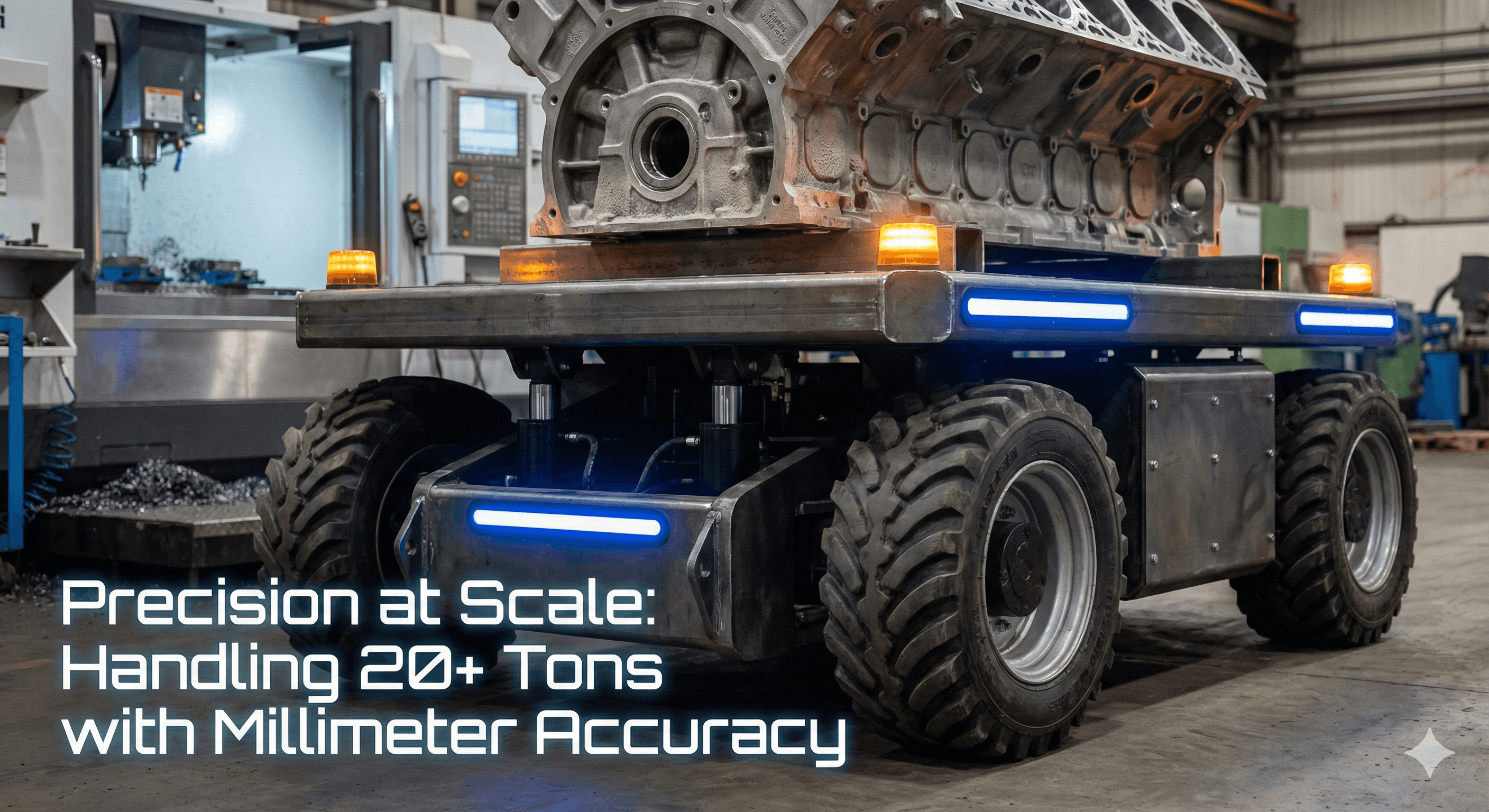
For industries dealing with automotive chassis, aerospace components, or heavy machinery, the Heavy-Duty AGV has become indispensable. These units are engineered for high-tonnage transport (often exceeding 20 tons) where manual handling is not just inefficient, but dangerous.
- Key Application: Moving raw castings from the foundry to the CNC machining center.
- The 2026 Advantage: Integrated hydraulic lifts and precision positioning (within ±5mm) allow these AGVs to place massive loads directly onto machine fixtures without human intervention.
2.2 High-Frequency Flow: Raw Materials and WIP
The “bread and butter” of manufacturing is the movement of Raw Materials and Work-In-Process (WIP). This is where Fork-style AGVs and Unit Load Carriers dominate.
- Raw Materials: Moving metals, chemicals, or plastics from receiving docks to temperature-controlled storage.
- WIP (Work-In-Process): Acting as the “connective tissue” between different production stages (e.g., moving semi-finished electronics from SMT lines to final assembly).
- Efficiency Metric: These systems are now judged by their “Battery-to-Work” ratio, with 2026 models utilizing ultra-fast charging that provides 4 hours of run-time for every 10 minutes of charging.
2.3 Line-Side & End-of-Line: Tuggers and AGCs
The final frontier of the factory floor is the narrow, high-traffic assembly line. Here, agility is more important than raw power.
- Tugger AGVs (The “Logistics Train”): These act as automated tow tractors, pulling a “train” of carts. They are the backbone of Milk Run delivery systems, dropping off full bins of small parts and picking up empties in a continuous loop.
- Automated Guided Carts (AGCs): The most cost-effective entry point into automation. Often used for “under-cart” transport, where the AGV tunnels beneath a trolley, hooks onto it, and moves it to the next station.
- Hospital and Cleanroom Use: In 2026, specialized AGCs with HEPA filtration and anti-microbial surfaces are standard in pharmaceutical manufacturing and high-end medical assembly.
2.4 The “Smart” Selection Matrix
When choosing, 2026 decision-makers use the following criteria:
- Load Characteristics: Is it palletized, caged, or a loose heavy component?
- Path Complexity: Is it a straight-line move (Unit Load) or a complex multi-stop route (Tugger)?
- Environment: Is the floor oily (requires high-traction wheels) or a cleanroom (requires low-particle emissions)?
Part 3: Technical Kernels—Navigation and the Safety Revolution
In 2026, the “brain” of the AGV is defined by two competing but increasingly integrated priorities: Path Freedom and Operational Safety. Understanding the interplay between these technologies is crucial for a future-proof deployment.
3.1 Navigation: The Spectrum of Freedom
While 20th-century AGVs were “on rails,” 2026 systems offer a spectrum of navigation depending on the stability of your environment.
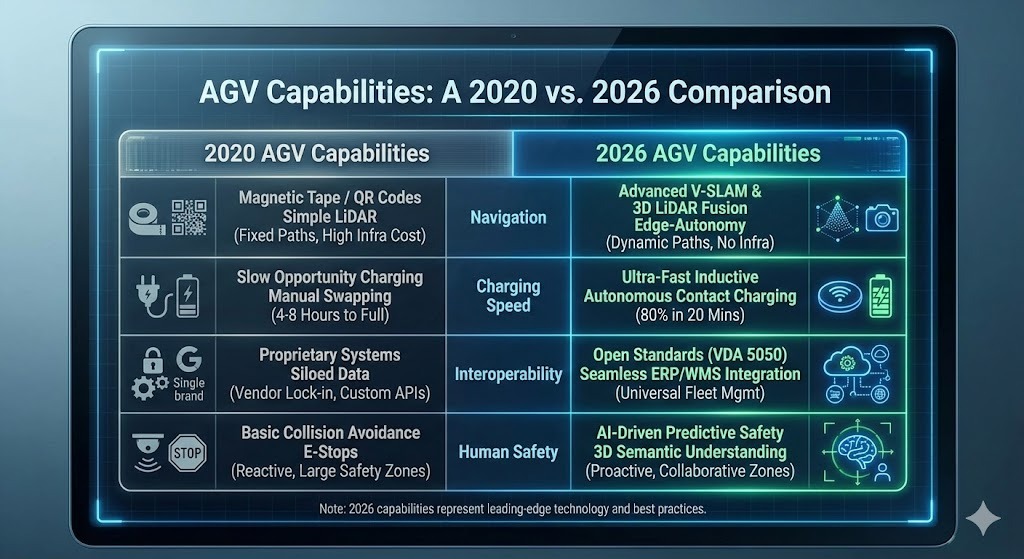
- Fixed Guidance (QR Codes & Magnetic Tape): Still the gold standard for high-speed, high-repetition environments (like sorting centers) where the layout never changes. It offers the highest reliability and lowest compute cost.
- LiDAR SLAM (Simultaneous Localization and Mapping): The industrial workhorse. Using laser pulses to create a 3D point cloud, these AGVs “see” walls and pillars to navigate without any floor markers.
- Visual SLAM (V-SLAM): The cutting edge in 2026. By using AI-powered cameras, AGVs can recognize specific objects (e.g., “that is the CNC machine,” “that is a fire extinguisher”) rather than just seeing geometric shapes. This allows for navigation in dynamic environments where pallets and boxes move constantly.
3.2 The Safety Architecture: Human-Machine Coexistence
Safety in 2026 is governed by the ISO 3691-4:2023 standard, which has evolved to address the complexities of autonomous mobile platforms. We no longer just “stop” when someone is in the way; we “collaborate.”
- Active Detection Zones: Modern AGVs utilize multi-modal sensor fusion. They combine 2D/3D LiDAR for long-range detection with Ultrasonic sensors for “blind spot” coverage and 3D Cameras to identify if an obstacle is a person or a cardboard box.
- Dynamic Speed Profiles: In 2026, AGVs don’t have a single “slow” speed. They use Adaptive Speed Control—calculating the braking distance in real-time based on the weight of the load and the friction of the floor.
- Cyber-Physical Safety: For the first time, safety includes Cybersecurity. Under the 2025 updates to ISO 10218, an AGV’s safety system must be hardened against unauthorized remote overrides to prevent “kinetic” cyber-attacks on the factory floor.
3.3 Connectivity: The 5G and IIoT Backbone
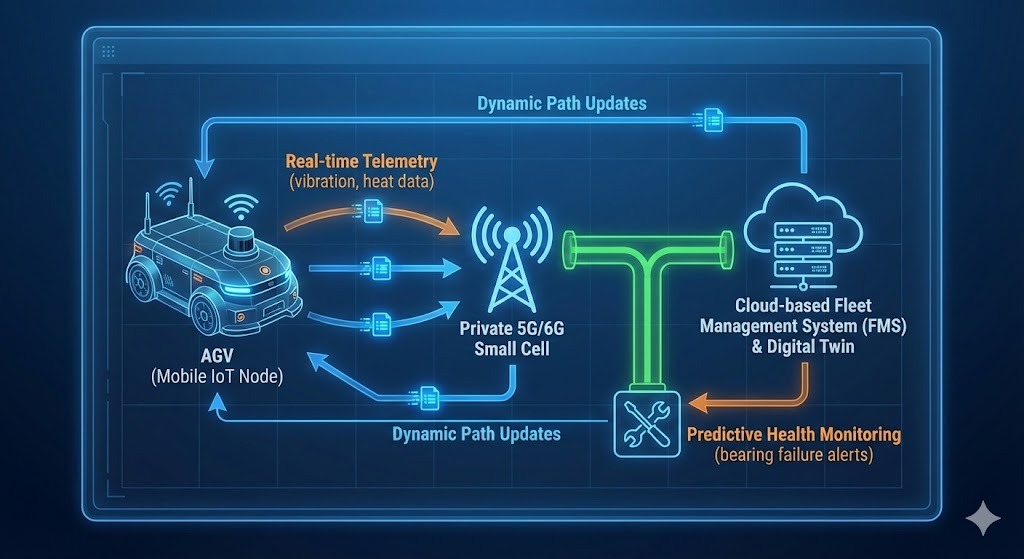
In 2026, an AGV is a “mobile IoT node.”
- Ultra-Reliable Low-Latency Communication (URLLC): Via private 5G/6G networks, AGVs communicate with the central Fleet Management System (FMS) with sub-10ms latency. This prevents “traffic jams” at intersections.
- Predictable Maintenance: Instead of scheduled checks, 2026 AGVs stream vibration and heat data from their drive motors to a digital twin. The system predicts a bearing failure weeks before it happens, scheduling a “pit stop” during a shift change.
Part 4: The Decision Arena—AGVs vs. The Alternatives
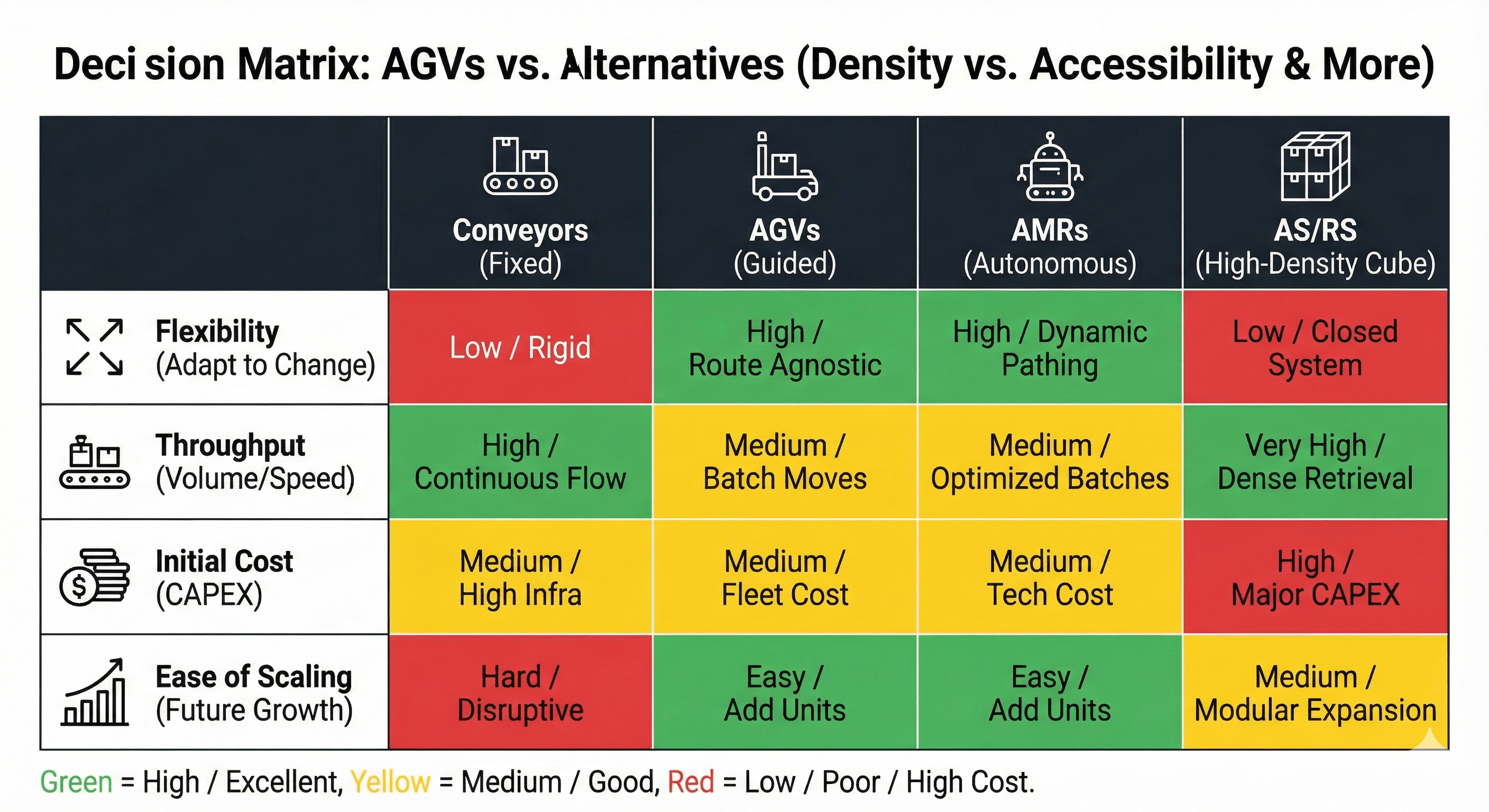
Choosing the right automation is not about buying the “best” technology; it’s about buying the right flexibility-to-throughput ratio. In 2026, we categorize the competition into three primary “battles.”
4.1 AGVs vs. Conveyors: Flexibility vs. Volume
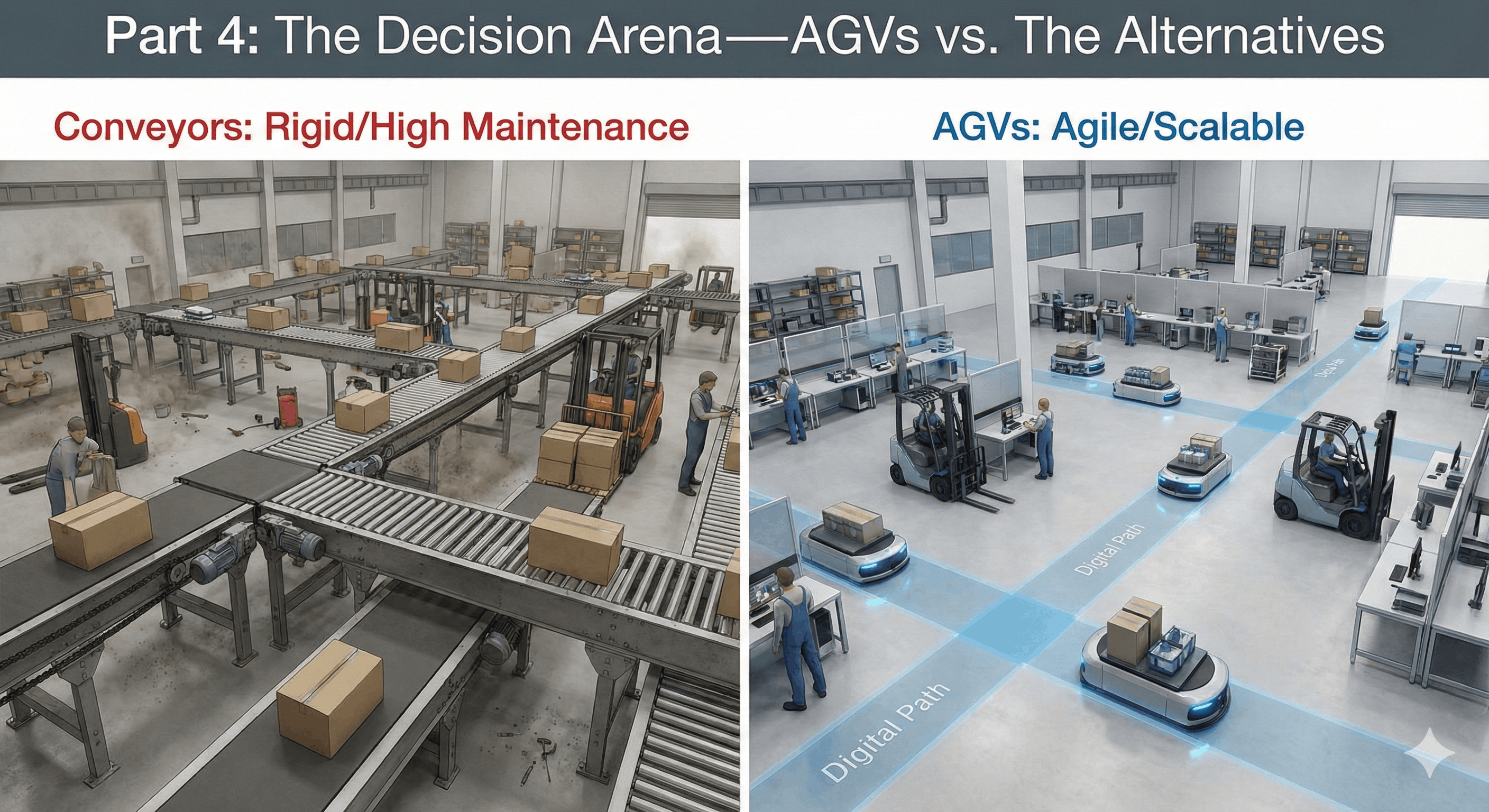
The oldest rivalry in material handling. While conveyors are the kings of pure volume, they are inherently “rigid.”
- The Case for AGVs: In 2026, product life cycles are shorter. AGVs allow you to reconfigure a factory layout over a weekend by simply updating a digital map. Conveyors, once bolted down, are expensive “monuments” that create physical barriers on the shop floor.
- The Verdict: Choose Conveyors for continuous, high-speed loops (e.g., bottling). Choose AGVs if your production layout needs to evolve or if you need to keep floor space open for human and forklift traffic.
4.2 AGVs vs. AMR (Autonomous Mobile Robots): The “Train” vs. The “Taxi”
This is the most debated comparison in 2026. While the lines are blurring, the distinction remains in the Navigation Logic.
- AGV (The Train): Operates on “virtual tracks.” It follows a set path and stops if an obstacle appears. It is highly predictable and ideal for stable, high-volume manufacturing lines.
- AMR (The Taxi): Uses dynamic path planning. If a box is in the way, it calculates a route around it. It is ideal for chaotic, constantly changing environments like e-commerce sorting or laboratory settings.
- The 2026 Reality: Most large-scale factories now use a Hybrid Fleet. AGVs handle the heavy, predictable long-haul transport, while AMRs handle the “last-meter” delivery to unpredictable workstations.
4.3 AGVs vs. AS/RS (Automated Storage and Retrieval Systems)
This comparison focuses on Density vs. Accessibility.
- AS/RS (Cube Storage): Maximizes vertical space. It is a “closed box” system that is incredible for high-density storage but limited in how it connects to the actual production line.
- The Synergy: In 2026, the trend is Integration. AS/RS acts as the “high-density heart,” while AGVs act as the “circulatory system,” fetching goods from the AS/RS output port and delivering them directly to the assembly cells.
4.4 The ROI Calculation: Beyond the Price Tag
In 2026, savvy CFOs look at TCO (Total Cost of Ownership) over 5 years.
- Direct Savings: Elimination of 2-3 shifts of manual forklift drivers.
- Indirect Savings: 90% reduction in product damage and “rack strikes.”
- Opportunity Gain: Reclaiming 20% of floor space previously dedicated to conveyor paths or wide forklift aisles.
Part 5: Implementation, Ecosystem Integration, and the 2030 Horizon
Deploying an AGV in 2026 is no longer a hardware project; it is a software orchestration project. To achieve true ROI, the vehicles must be part of a seamless digital thread.
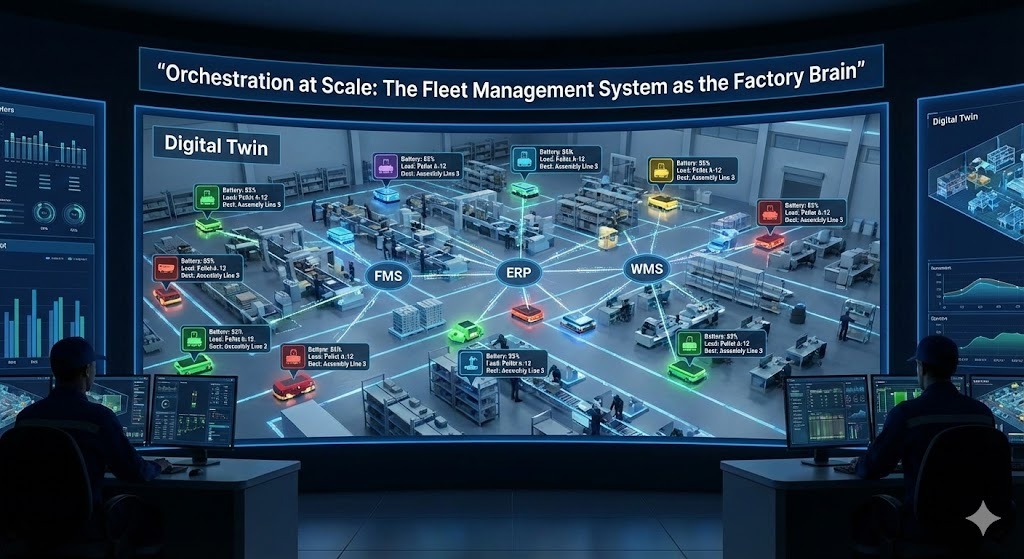
5.1 The “Digital Nervous System”: WMS and ERP Integration
An AGV is only as smart as the data it receives. In modern manufacturing, we focus on Interoperability.
- Fleet Management Systems (FMS): This is the “air traffic control” of the factory. It manages traffic flow, battery levels, and task prioritization.
- The VDA 5050 Standard: In 2026, leading manufacturers insist on VDA 5050 compliance, allowing a single software platform to manage AGVs and AMRs from different brands simultaneously.
- ERP/WMS Linkage: When an order is placed in the ERP, the WMS automatically triggers the AGV to move the required raw materials. There is zero manual data entry, eliminating the “information lag” that plagues manual warehouses.
5.2 Case Study: The Power of Integration (The “Sport Okay” Model)
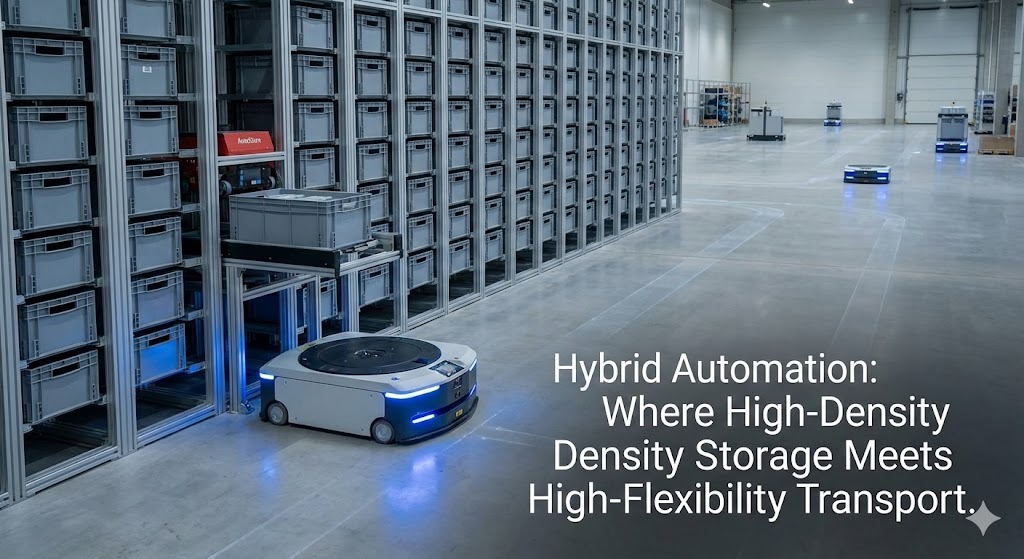
A prime example of 2026 excellence is the integration of AutoStore (Cube Storage) with AGVs.
- The Challenge: High-density storage systems like AutoStore are excellent at picking, but they are often “landlocked” by fixed conveyors.
- The Solution: Instead of rigid conveyors, a fleet of AGVs acts as the flexible link. Once the AutoStore robots pick an item, an AGV transports the bin directly to the packing station or the shipping dock.
- The Result: This “Hybrid Automation” approach allows for 24/7 operation with 40% less floor space than a conveyor-based system, as seen in the Sport Okay fulfillment model.
5.3 Looking Ahead: The Future Toward 2030
As we look beyond 2026, three trends are emerging:
- Energy Harvesting: AGVs that charge wirelessly via induction loops embedded in the floor, eliminating charging downtime entirely.
- Swarm Intelligence: AGVs that make collective decisions without a central server, mimicking the efficiency of a beehive.
- Sustainability (Green Logistics): 2026 models are now 98% recyclable, with “Second-Life” battery programs that repurpose old AGV batteries for stationary factory energy storage.
Conclusion: A Strategic Analogy for the C-Suite
To simplify the complex landscape of 2026 material handling, imagine your factory as a busy city:
- Traditional Conveyors are like the Subway: High capacity and fast, but they only go where the tracks are laid. If you want to change the route, you have to dig up the city.
- AMRs (Autonomous Mobile Robots) are like Taxis: They can go anywhere and find their own way through traffic, but they can be less predictable in high-volume, repetitive “commutes.”
- AGVs (Automated Guided Vehicles) are like Trams or Light Rail: They are efficient, incredibly reliable, and follow optimized, high-speed routes. They are the core arteries that keep the city’s functional zones connected, ensuring that the lifeblood of your production never stops flowing.
In 2026, the most successful “cities” (factories) are those that use a mix of all three, but rely on the AGV as their dependable, high-performance backbone.
Part 6: The 2026 Implementation Roadmap & FAQ
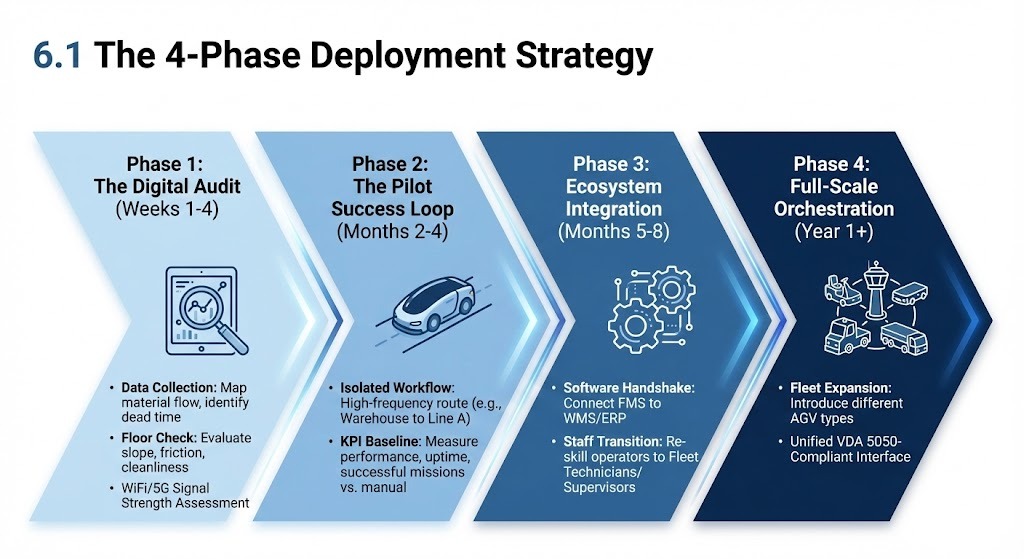
Successfully deploying an AGV system is a journey of “Start Small, Scale Fast.” In 2026, the industry has standardized a four-phase approach to minimize risk and maximize early ROI.
6.1 The 4-Phase Deployment Strategy
Phase 1: The “Digital Audit” (Weeks 1-4)
- Data Collection: Before buying hardware, use sensors or manual tracking to map your current material flow. Identify “dead time” where materials sit idle.
- Floor Check: Evaluate floor conditions (slope, friction, and cleanliness) and WiFi/5G signal strength in all corners of the facility.
Phase 2: The Pilot “Success Loop” (Months 2-4)
- Isolated Workflow: Choose one high-frequency, low-complexity route (e.g., Warehouse to Production Line A).
- KPI Baseline: Measure the AGV’s performance against manual forklift metrics. Focus on uptime and “successful missions” without human intervention.
Phase 3: Ecosystem Integration (Months 5-8)
- Software Handshake: Connect the Fleet Management System (FMS) to your WMS/ERP.
- Staff Transition: Re-skill your forklift operators to become “Fleet Technicians” or “Automation Supervisors.” In 2026, the goal is to elevate your workforce, not just replace it.
Phase 4: Full-Scale Orchestration (Year 1+)
- Fleet Expansion: Introduce different types of AGVs (e.g., adding Heavy-Duty units to your existing Tugger fleet) and manage them through a unified VDA 5050-compliant interface.
6.2 Frequently Asked Questions (The 2026 Checklist)
Q: What is the typical ROI period for an AGV system today? A: In 2026, due to the maturity of the technology and rising labor costs, most manufacturing deployments reach a “break-even” point within 18 to 24 months. In 24/7 high-intensity operations, this can be as short as 14 months.
Q: Can AGVs work on uneven floors or outdoors? A: While standard AGVs require flat indoor floors, 2026 has seen the rise of “Rugged-Terrain AGVs” with advanced suspension and IP65-rated enclosures for outdoor use (e.g., moving goods between two different factory buildings).
Q: What happens if the 5G/WiFi network goes down? A: 2026 models feature “Edge-Autonomy.” While they prefer to be connected for task updates, the safety systems and basic navigation maps are stored locally on the vehicle. If the network drops, the AGV will safely complete its current task or move to a designated “Safe Zone” and wait for instructions.
Q: How do we handle maintenance in a “Lights-Out” factory? A: Most 2026 systems utilize Predictive Maintenance (PdM). The AGV will literally “tell you” when it needs service by monitoring the heat in its motors or the wear on its tires, often alerting you weeks before a failure occurs.
Final Summary: The 2026 Advantage
The transition to AGVs is no longer a luxury for the industrial elite; it is a prerequisite for competitiveness in the late 2020s. By shifting from manual, unpredictable transport to a deterministic, data-driven autonomous fleet, manufacturers can finally close the gap between digital planning and physical execution.
The future of manufacturing isn’t just about making things—it’s about making things move smarter.


 عربى
عربى