Quick Answer
To use a pallet truck: (1) inspect the truck before every shift, (2) insert both forks fully under the pallet until the load rests against the fork backrest, (3) raise the forks just enough to clear the floor - 2 to 6 inches, (4) walk ahead of the truck and push it to the destination, (5) lower the forks completely before walking away. Never ride the forks, never exceed the rated capacity on the data plate, and never leave a raised load unattended.
Key Operating Stats
- 2-6 in (Travel height): Always travel with forks at minimum clearance height - never fully raised
- 3 mph (Max safe speed): Slow walking pace in pedestrian areas - always yield to people on foot
- 100% (Fork insertion): Both forks must be fully under the pallet - never half-inserted
- OSHA 29 CFR 1910.178: Electric pallet trucks are powered industrial trucks - training and certification required
1. Manual vs. Electric Pallet Truck: Know Which One You Are Using
The basic operating steps are similar for both types, but the controls, hazards, and certification requirements differ. Before you operate any pallet truck, confirm which type it is.
| Feature |
Manual Pallet Truck |
Electric Pallet Truck (Walkie) |
| Lifting power |
Operator pumps handle to raise forks |
Electric motor raises forks via button or trigger |
| Travel power |
Operator pushes or pulls by hand |
Electric drive motor controlled by thumb throttle or tiller |
| Capacity |
Typically 2,500 - 5,500 lb (1,000 - 2,500 kg) |
Typically 2,200 - 6,600 lb (1,000 - 3,000 kg) |
| OSHA classification |
Not classified as a powered industrial truck if hand-propelled only |
Powered industrial truck - operator training and certification required under 29 CFR 1910.178 |
| Key hazard difference |
Operator fatigue; ergonomic strain on long distances |
Pinch/crush hazard from drive motor; higher travel speed; battery management required |
| Typical Hangcha model |
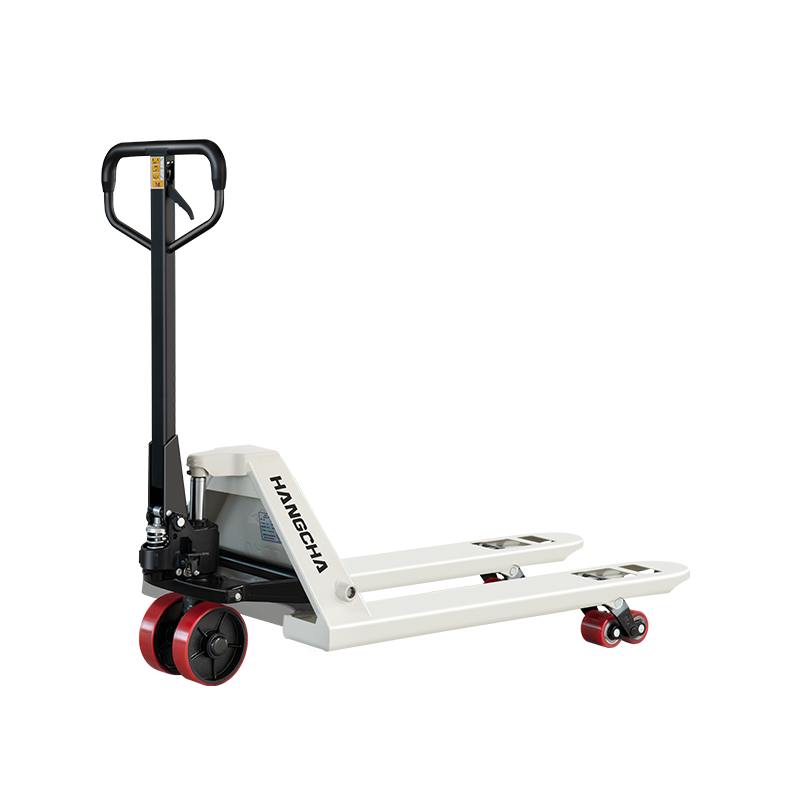
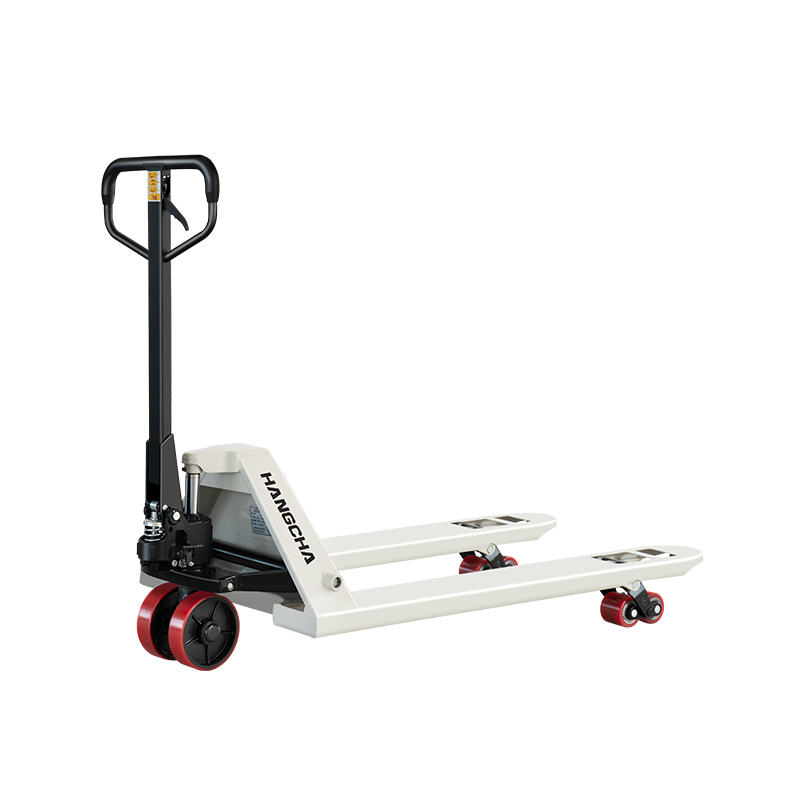
CBD15-AMA, CBD20-AMA (1.5 t - 2.0 t manual) |
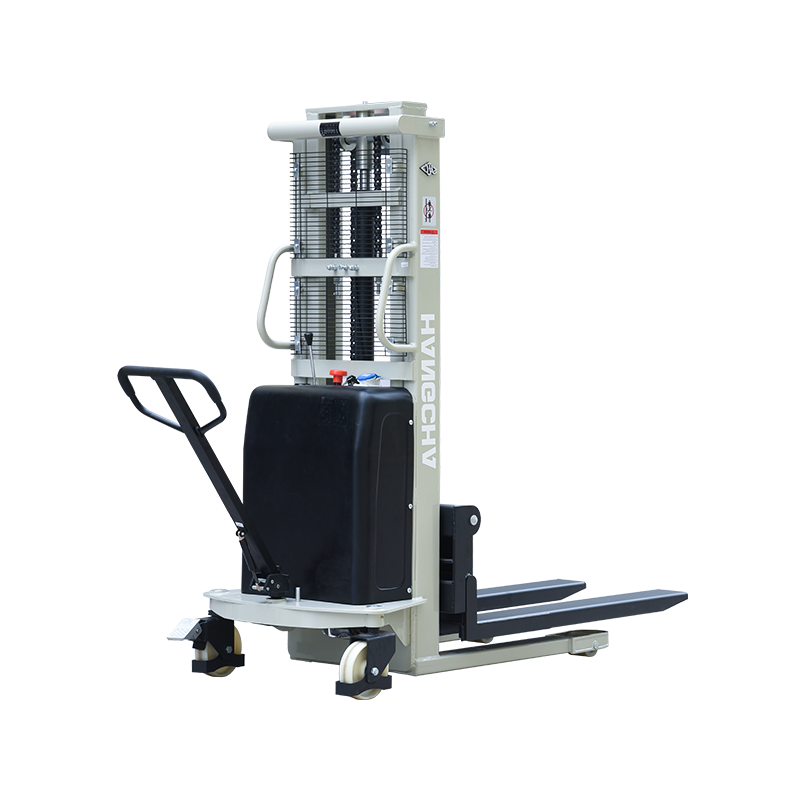
CBD15-A2MC1, CBD20-AMC1, CBD20-AEC1 (walkie electric) |
Training requirement: Electric pallet trucks are classified as powered industrial trucks under OSHA 29 CFR 1910.178. Operating one without documented training and employer authorization is a violation. Manual hand pallet trucks do not require OSHA certification but do require safe work instruction. Check your employer’s policy before operating either type.
2. Know the Controls Before You Move
Layouts vary between models. Study the controls on your specific truck before operating. The following covers the standard control set on Hangcha walkie electric pallet trucks (CBD-series), which matches the industry-standard layout.
Tiller Head Controls - Hangcha CBD-Series Walkie Electric Pallet Truck
- Thumb Throttle: Press forward = travel forward. Press back = travel in reverse. Release = automatic braking. This is the primary drive control.
- Lift Button: Press and hold to raise forks. On most models located on the right side of the tiller head or integrated into the horn button cluster.
- Lower Button / Lever: Press to lower forks. On manual trucks, turn or press the handle control valve. Lowering is gravity-assisted - do not lower onto people or obstructions.
- Horn: Use at every intersection, blind corner, and doorway - even if the area looks clear. Required under OSHA operating rules.
- Emergency Reverse (Belly Button): A raised button on the back of the tiller. If pressed - by your body being pushed against it - the truck automatically reverses away from you. This is a pinch protection device. Never tape or disable it.
- Tiller Angle = Brake: On most walkie electric pallet trucks, moving the tiller to fully vertical or fully horizontal applies the brake automatically. Letting go of the tiller stops the truck.
Manual pallet truck controls are simpler: the handle has a three-position valve built into the grip or activated by a lever underneath. Neutral = forks hold position. Pump = raises forks with each handle stroke. Lower = releases pressure, forks descend by gravity.
3. Pre-Shift Inspection: Do This Before Every Use
OSHA requires a pre-shift inspection of every powered industrial truck before each shift. For electric pallet trucks this is mandatory. For manual pallet trucks it is best practice that most employer safety programs require. The inspection takes about 3 minutes and catches the problems that cause accidents.
Walk-around inspection sequence:
- Forks: No cracks, bends, or unusual wear. Both forks level with each other. Fork tips not cracked or broken. Heel area (where fork meets the crossbar) not worn thin.
- Load wheels (under forks): Not cracked, flat, or missing. Spin freely. On nylon wheels, check for chunks missing - a damaged load wheel causes the fork to drag and can damage pallets and floors.
- Drive wheel (under tiller): No flat spots or excessive wear. Polyurethane drive wheels should be smooth and round. Worn flat drive wheels cause poor steering and heavy battery drain on electric models.
- Hydraulic system: No oil on the floor or on the pump housing. Forks raise and lower smoothly when tested. A small puddle of oil under the pump is a tag-out condition.
- Tiller and handle: Moves freely through full range. No cracks in handle or tiller arm. On electric models, all buttons and throttle respond correctly.
- Battery (electric only): Charge level is sufficient for the shift. Connector is secure. No visible damage to battery casing or cable. Check charge indicator - do not begin a shift on a critically low charge.
- Emergency reverse button (electric only): Press it deliberately and confirm the truck reverses. This confirms the safety system is active. Takes 3 seconds and can save a serious injury.
- Data plate: Present and legible. Rated capacity is known. Never operate a truck with a missing or unreadable data plate.
If you find a defect: Tag the truck out of service immediately. Do not operate it and do not leave it where someone else might. Attach a lockout tag and notify your supervisor. A defective truck must be repaired and cleared by maintenance before it returns to service.
4. Picking Up a Load: Step by Step
- Check the load before approaching: Verify the load weight is within the rated capacity on the data plate. Check that the pallet is in good condition - no broken boards, no protruding nails, no overhang beyond the pallet edge.
- Lower the forks fully before approaching the pallet: Forks must be at their lowest position to enter the pallet entry points cleanly. Approach slowly and in a straight line.
- Insert both forks fully - until the load rests against the fork backrest: This is the single most important step. Both fork tines must go all the way under the pallet until the load or pallet face contacts the vertical backrest plate.
- Raise the forks just enough to clear the floor: Lift to 2 to 6 inches (50 to 150 mm) off the floor - just enough to clear floor irregularities and dock plates. Do not raise higher for travel.
- Check that the load is stable before moving: Look at the load from both sides. Is it leaning? Is anything hanging over the edge?
- Check your planned route before moving: Look ahead along the path. Are there pedestrians? Obstructions? On electric pallet trucks, sound the horn before moving off.
5. Travelling with a Load: Rules That Prevent the Most Common Accidents
| Rule |
Why It Matters |
| Walk ahead of the truck, slightly to one side |
You can see where you are going. If the load blocks your view, you cannot avoid pedestrians or obstacles. |
| Push - do not pull |
Pushing keeps the load in front where you can see it and gives you better control. |
| Keep forks at 2 to 6 inches travel height |
Higher travel height raises the center of gravity. A sharp turn with a raised load can tip the load sideways. |
| Sound horn at every blind spot |
Intersections, doorways, corners, and ramp tops. Do it every time. |
| Slow down for turns |
The load’s inertia continues forward when the truck turns. A tight turn at speed can topple the load sideways. |
| Yield to pedestrians - always |
People on foot always have right of way over powered equipment. |
| Do not ride the forks |
People have died falling from pallet truck forks. It is an OSHA violation. |
| Do not allow passengers |
Pallet trucks are designed for one operator. |
6. Ramps and Slopes: The Highest-Risk Travel Situation
- Going UP a ramp loaded: Load faces uphill. Push the truck forward. Your body is behind the load, uphill side. Forks point up the ramp.
- Going DOWN a ramp loaded: Load faces uphill (same rule). Back the truck down the ramp. Your body is above the load. You walk down facing the load.
- Unloaded travel on ramps: Reverse the rule: forks point downhill on both up and down ramp travel. This keeps the heavy counterweight uphill for stability.
- Never turn on a ramp: Only travel straight up or straight down.
7. Setting Down a Load
- Position the truck squarely at the drop location: Approach straight, not at an angle.
- Lower the forks slowly until the pallet rests on the floor: Never drop the load.
- Continue lowering until the forks are fully at their lowest position: The forks must clear the pallet entry points completely before you reverse out.
- Reverse straight back out from the pallet: Move in a straight line until the fork tips clear the pallet face completely before turning.
- Confirm the load is stable before walking away: Is it level? Is it stable?
8. Parking and End-of-Shift Procedure
- Lower forks completely to the floor before walking away from the truck - every time, no exceptions.
- Park in the designated area - not in an aisle, not blocking emergency exits, not in a pedestrian walkway.
- Electric pallet trucks: Remove the key or key card. Set the handle to the braking position. Connect to charger if applicable.
- Report any issues found during the shift in writing before the next operator takes the truck.
- Do not leave a raised load unattended - if you must leave the truck, lower the load first.
Frequently Asked Questions
Do I need a license to operate a pallet truck?
For electric pallet trucks, yes - OSHA classifies them as powered industrial trucks under 29 CFR 1910.178, requiring documented employer-provided training. Manual hand pallet trucks do not require formal certification.
What is the difference between a pallet truck and a pallet jack?
They are the same equipment. Both terms refer to a hydraulic lifting unit with two fork tines designed to move standard pallets at floor level.
How high can a pallet truck lift?
Standard pallet trucks lift the forks to approximately 7 to 8 inches (175 to 200 mm) above the floor. They are not designed for racking or stacking.
Can one person operate a pallet truck alone?
Yes - pallet trucks are designed for single-operator use. However, if your load blocks forward visibility completely, OSHA recommends using a spotter.
What should I do if the pallet truck loses power mid-operation?
Stop immediately. On most electric pallet trucks, the lowering function is gravity-assisted and will still work without power - use the lower button or lever to bring the forks down to the floor.
References
- OSHA. 29 CFR 1910.178 - Powered Industrial Trucks.
- OSHA. Powered Industrial Trucks eTool - Walkie / Rider Trucks.
- Hangcha Group Co., Ltd. Operation and Maintenance Manual - CBD Series Pallet Trucks.
Published by
Hangzhou Hangcha E-Commerce Co., Ltd.
Nr. 818 Jinyuan Road
Yinzhou District, Ningbo 315100
Zhejiang, China
Hangcha Group Co., Ltd.
Stock Code: SH 603298
Founded 1956 - Hangzhou, China
Web: www.hf-ec.com
© 2026 Hangzhou Hangcha E-Commerce Co., Ltd. All rights reserved.


 عربى
عربى