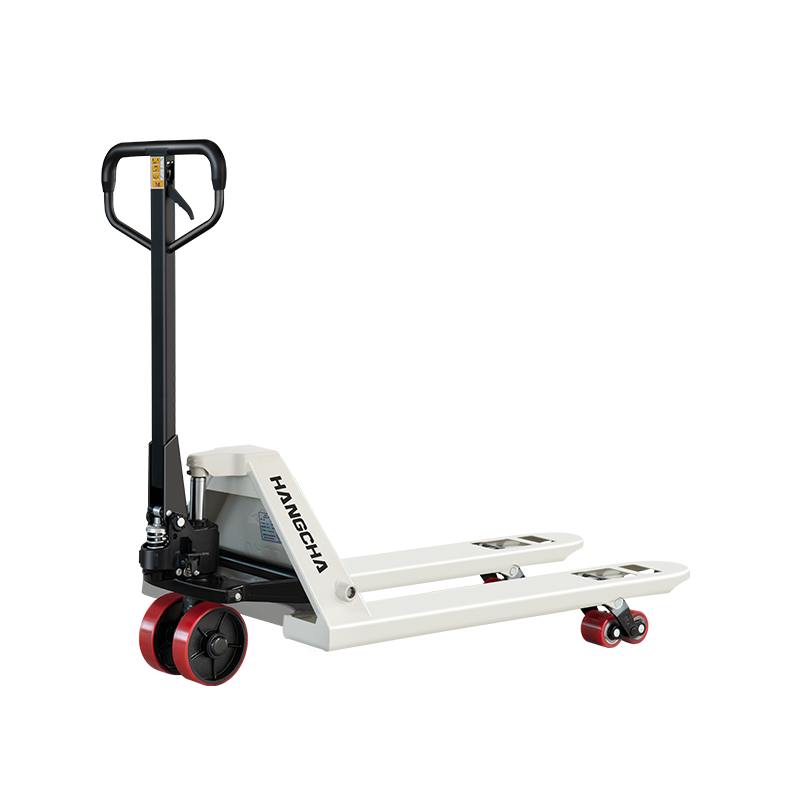
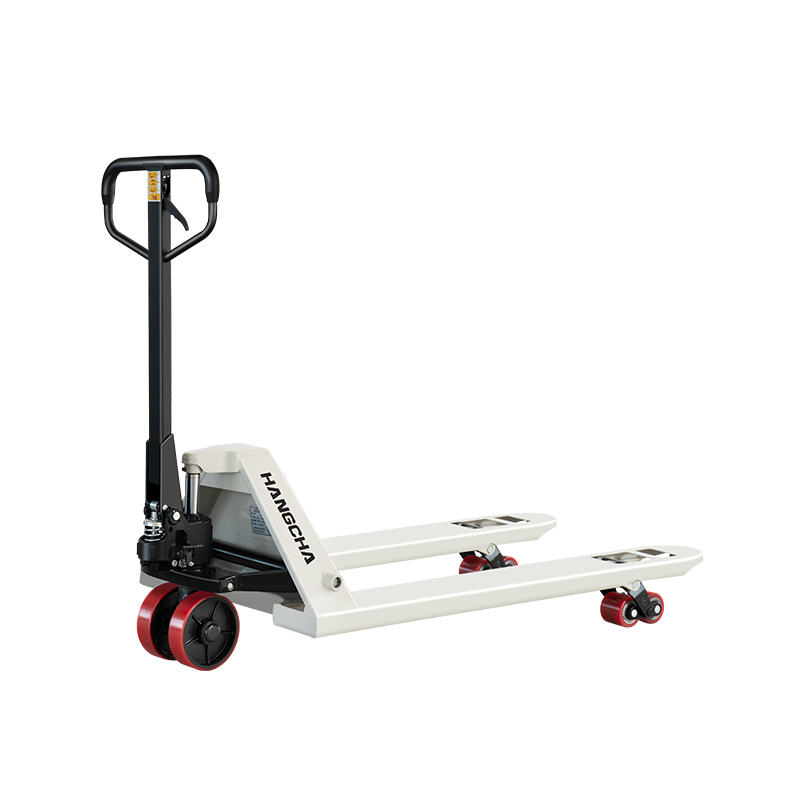
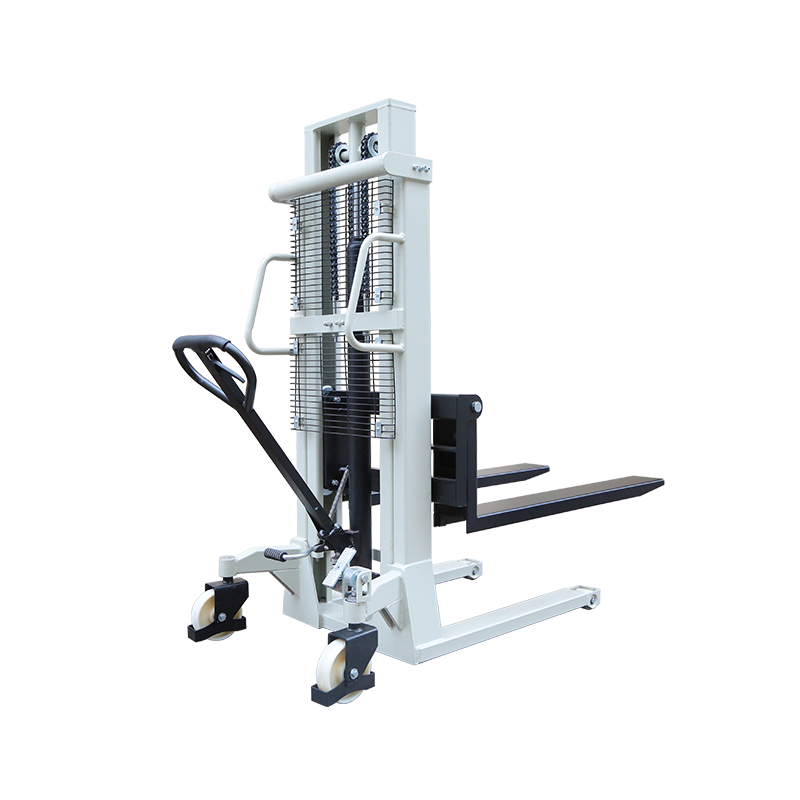
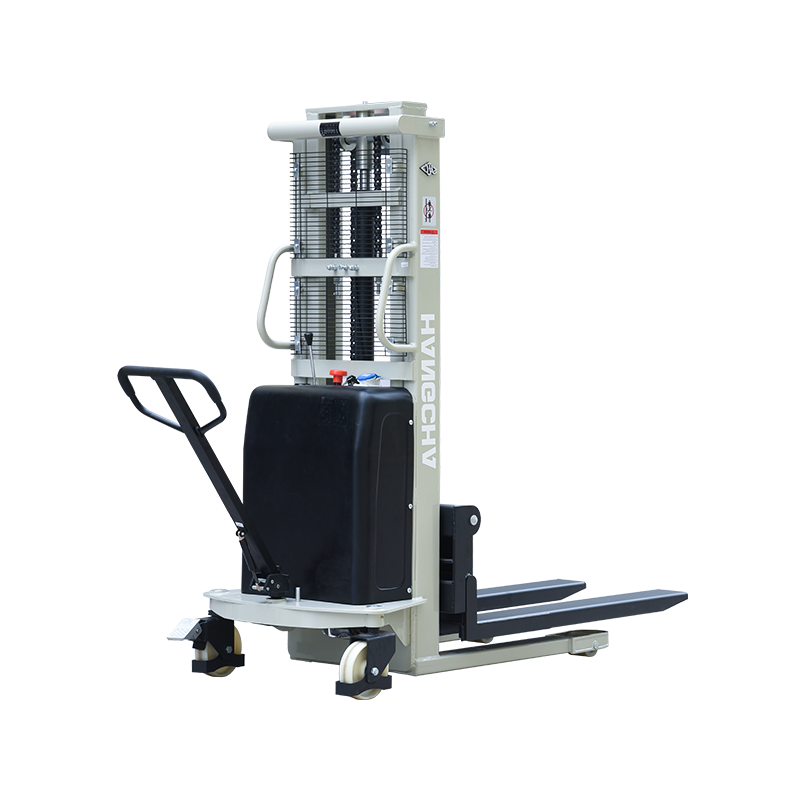
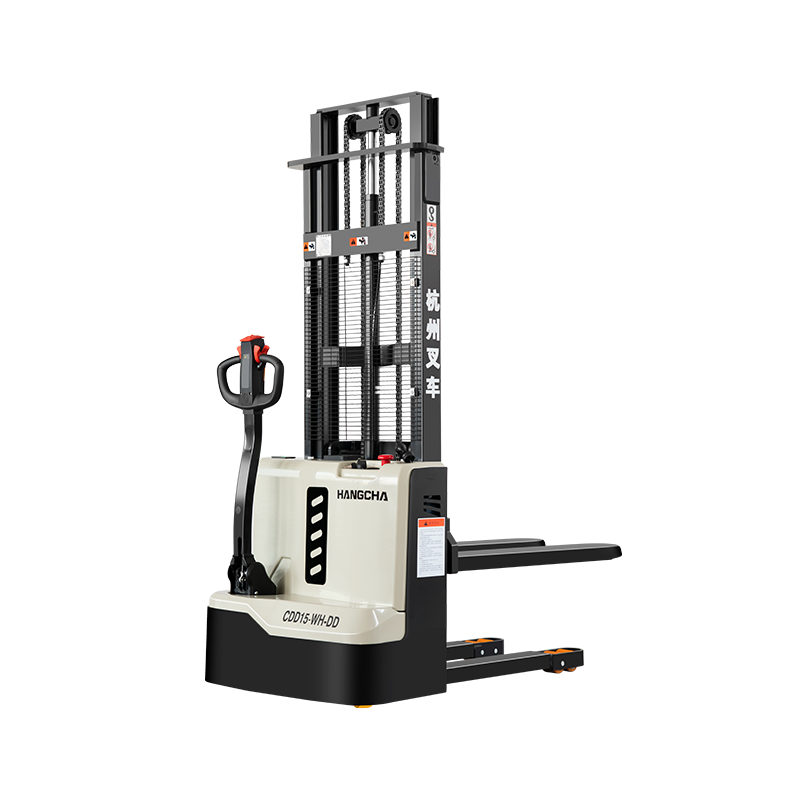
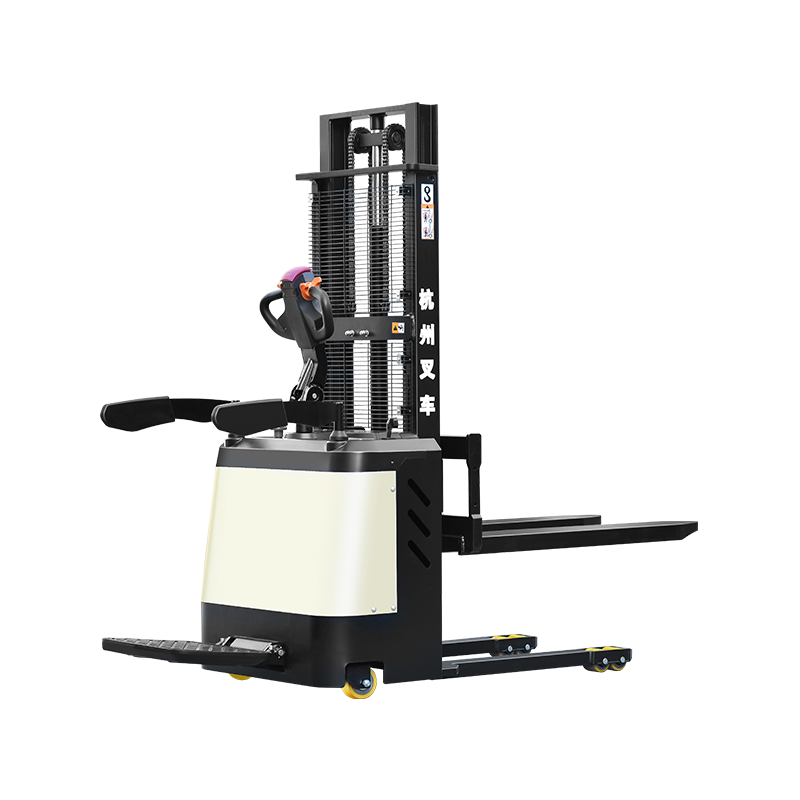
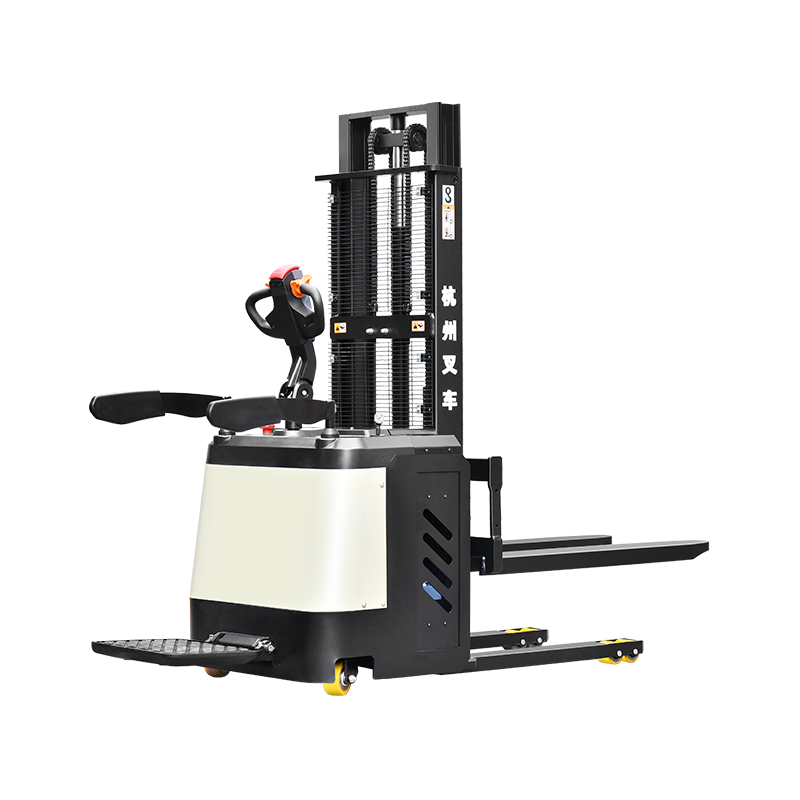
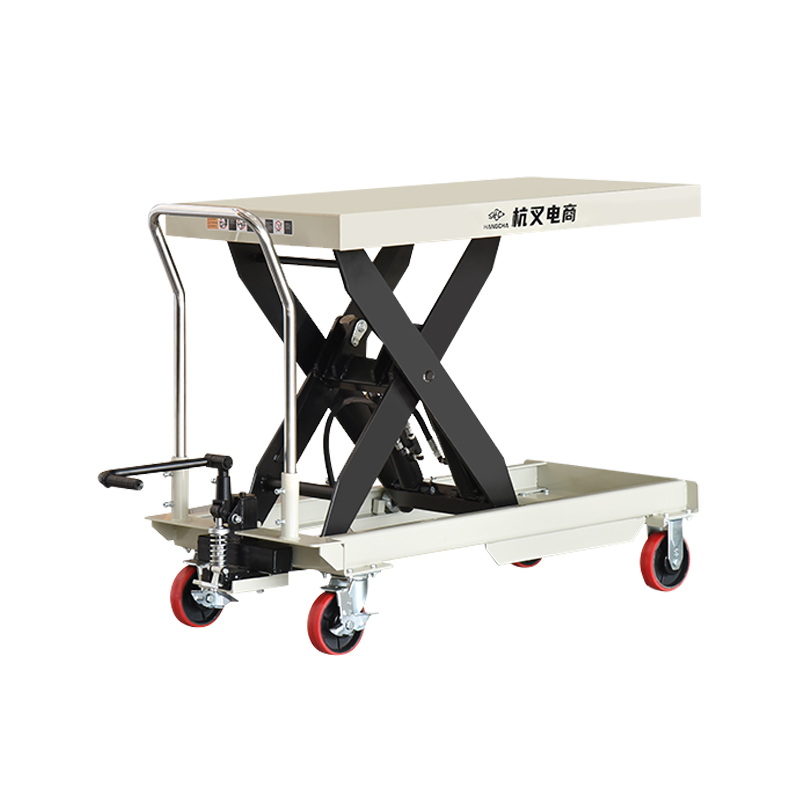
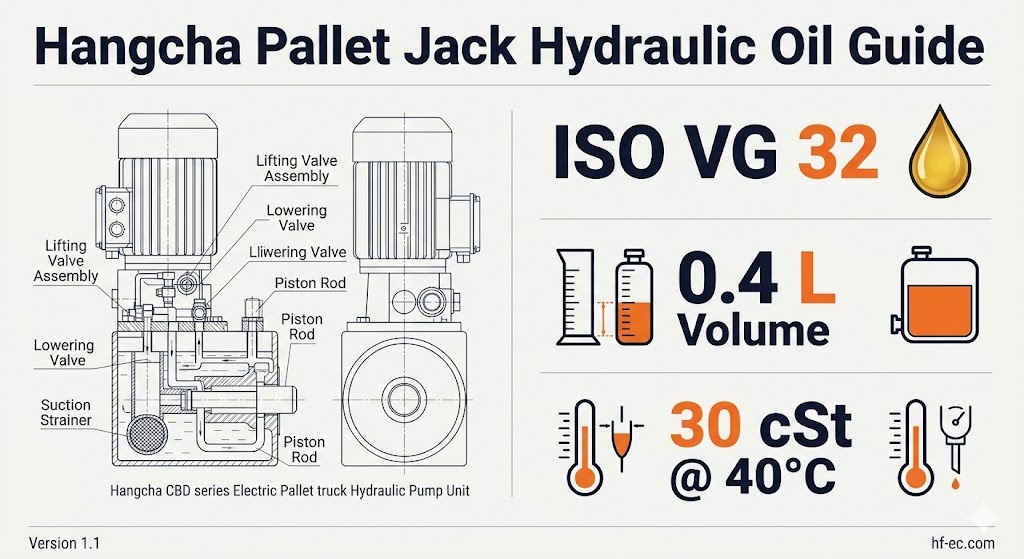
Hangcha pallet trucks use ISO VG 32 hydraulic oil with a viscosity of 30 cSt at 40 deg C. This applies to all CBD-series models - manual, electric, and mini-range. Reservoir capacity is approximately 0.4 liters on manual models. Check every 6 months; replace every 2,000 hours or annually on electric models. Never substitute motor oil, ATF, or brake fluid - wrong viscosity destroys pump seals and voids the warranty.
ISO VG 32
Specified grade
All Hangcha CBD-series pallet trucks
30 cSt
Viscosity at 40 deg C
Per Hangcha service manual specification
0.4 L
Reservoir volume
Manual pallet truck hydraulic cylinder
2,000 hr
Change interval
Or annually - whichever comes first on electric models
1. The Exact Specification: What Hangcha Manuals Say
Hangcha publishes the hydraulic oil specification in the operation and maintenance manuals for all CBD-series pallet trucks. The specification is consistent across the range:
Parameter
Specification
Notes
Oil grade
ISO VG 32
Anti-wear (AW) additive package preferred
Viscosity at 40 deg C
30 cSt (centistokes)
Handle becomes hard to pump if viscosity is too high; forks may drift if too low
Fluid type
Mineral-based hydraulic oil
Synthetic ISO VG 32 is acceptable as a direct substitute
Reservoir volume (manual)
~0.4 L
Fill to the fill plug opening - do not overfill
Check interval
Every 6 months
Also check after any suspected leak or unusual operation
Replacement interval (electric)
Every 2,000 service hours or annually
Whichever comes first; reduce interval in dusty or high-temperature environments
Cold storage variant
Low-pour-point ISO VG 32
Rated to -20 deg C or lower; standard VG 32 thickens and causes slow or failed lifting in cold rooms
Source: Hangcha Group operation and maintenance manuals for CBD15-AMA-SI, CBD15-A2MC1, CBD20-AEC1, and CBD20/30-AC1S-SU series. The specification is identical across all manual and electric CBD pallet truck models. Always verify against your specific model's manual before servicing.
2. Understanding ISO VG 32: What the Grade Actually Means
ISO VG (Viscosity Grade) is the global classification system for hydraulic oil published by the International Organization for Standardization. The number refers to the oil's kinematic viscosity in centistokes (cSt) measured at 40 deg C - the standard reference temperature for hydraulic systems.
ISO VG Grade
Viscosity at 40 deg C
Typical Application
Pallet Jack Suitability
ISO VG 22
22 cSt
Precision machine tools, very cold environments (below -15 deg C)
Cold storage only - too thin for standard use, forks may drift
Hangcha specified grade - correct for all standard environments
ISO VG 46
46 cSt
Outdoor forklifts, excavators, hot climate applications
Acceptable in hot outdoor environments above 35 deg C; handle may feel stiff in cold
ISO VG 68+
68 cSt and above
Heavy construction, high-pressure systems, gear boxes
Too thick - causes hard pumping, slow lifting, and pump damage
Motor oil (SAE 10W-30 etc.)
Varies widely, detergent additives
Engine lubrication
Never use - detergents cause foam and destroy rubber seals
ATF (automatic transmission fluid)
~33-38 cSt
Transmission systems
Never use - additive package swells and degrades pallet jack seals
Brake fluid
Varies, hygroscopic
Braking systems
Never use - absorbs water, corrodes cylinder walls and seals
Why does viscosity matter so much in a pallet jack? The hydraulic cylinder in a pallet truck is a high-pressure, low-volume system. Unlike a forklift's large hydraulic circuit, there is very little margin for error. Oil that is too thick cannot flow fast enough through the small-bore pump passages - the handle becomes hard to pump and lifting slows or stops in cold conditions. Oil that is too thin cannot maintain pressure in the cylinder - forks gradually drift down under load, which is both a product damage and a safety risk.
3. Recognizing Contaminated or Degraded Oil
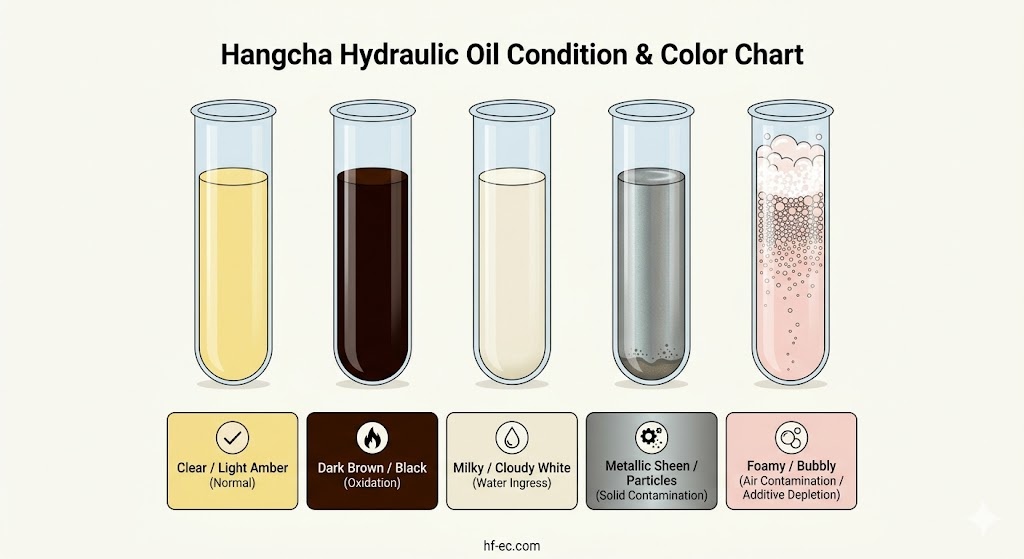
The fastest way to diagnose a hydraulic problem in a pallet jack is to look at the oil before anything else. Most faults that get misdiagnosed as pump or seal failure are actually oil contamination problems that cost almost nothing to fix.
Clear / Light Amber
Normal. Fresh ISO VG 32 is pale yellow to amber. If it looks like this and is at the right level, the hydraulic system is healthy.
Dark Brown / Black
Oxidation - oil has overheated or is well past service life. Replace immediately. Do not top up with new oil; drain completely before refilling.
Milky / Cloudy White
Water ingress - most common in cold storage trucks (condensation) or after a washdown. Water destroys the additive package and corrodes the cylinder. Drain, flush, refill.
Metallic Sheen / Particles
Solid contamination - wear debris or seal fragments. Drain, flush, inspect pump and cylinder for damage, then refill. May indicate impending seal or pump failure.
Foamy / Bubbly
Air contamination or additive depletion. Caused by wrong oil type, overfilling, or a damaged seal letting air into the suction side. Bleed air per procedure; check oil type.
Symptom
Most Likely Cause
First Action
Forks won't lift / handle feels empty
Low oil level; air in system
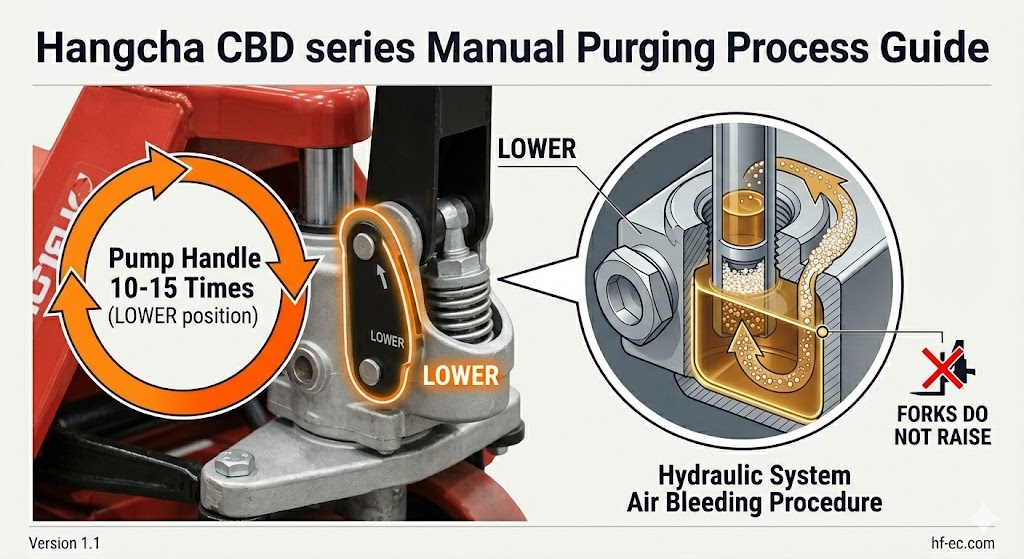
Check level; top up; bleed air (10-15 handle pumps in LOWER position)
Bleed air procedure; if persists, drain and replace oil
Oil leaking from cylinder or pump housing
Seal failure; overfill; wrong oil damaging seals
Tag out truck; inspect seals; do not continue operation with active leak
Forks won't lower / lower too fast
Lowering valve misadjusted; wrong oil viscosity
Adjust lowering valve per manual; verify oil grade
4. Step-by-Step: How to Check and Top Up Hydraulic Oil
Hangcha recommends checking the hydraulic oil level every 6 months under normal operation. The procedure is straightforward but must be done with the forks fully lowered - checking with the forks raised gives a false reading because oil has moved into the cylinder.
1
Lower the forks completely to the floor Set the control lever to LOWER and allow the forks to reach their lowest position. All oil must be back in the reservoir for an accurate level check. Do not perform this step with a load on the forks.
2
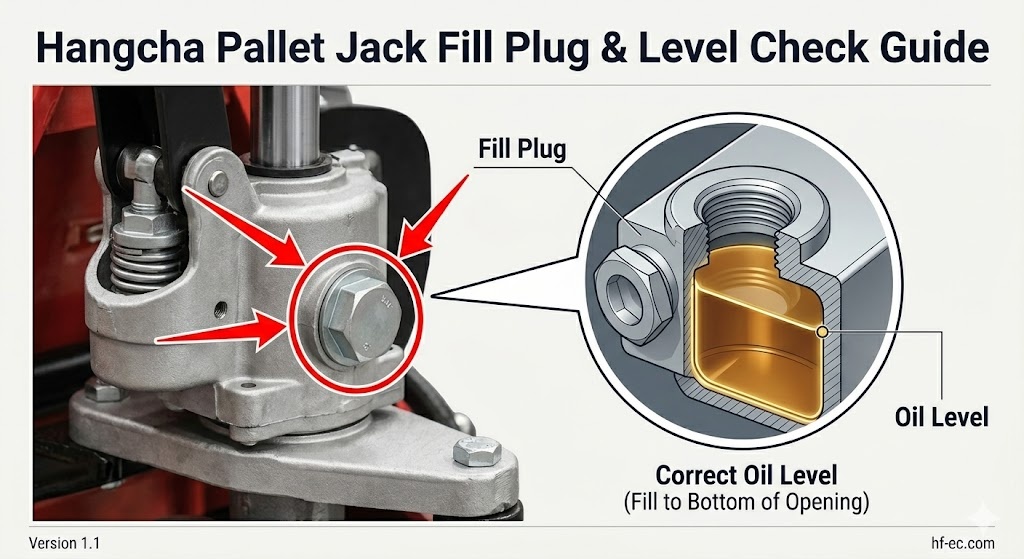
Locate the fill plug on the hydraulic pump unit On manual CBD-series pallet trucks, the hydraulic pump is at the base of the handle. The fill plug is on the side of the pump housing - usually a hex plug or a slotted plug with a washer. Clean the area around the plug before opening to prevent contamination entering the reservoir.
3
Remove the fill plug and inspect the oil The oil level should be at or near the fill plug opening. Use a clean lint-free cloth or a dipstick to draw a sample. Check the color: clear amber = normal; milky = water contamination; dark brown = oxidation; metallic sheen = wear debris. Any contamination other than normal darkening means drain and replace - do not top up.
4
Add ISO VG 32 hydraulic oil if below level Use a clean funnel or syringe to add oil slowly. Fill to the bottom of the fill plug opening - approximately 0.4 L total capacity. Do not overfill: excess oil has nowhere to go when the cylinder extends and will force out through the seals, appearing as a leak.
5
Replace the fill plug and washer securely Hand-tighten first, then snug with a wrench. A loose plug will leak under operating pressure. Replace the washer if it is deformed or damaged - a flat rubber washer is the only seal between the reservoir and atmosphere.
6
Bleed trapped air from the system Set the control lever to LOWER. Pump the handle 10 to 15 times. This moves oil through the circuit and purges any air introduced during the service. Air in the system causes the same symptoms as low oil level - erratic or failed lifting - so this step is not optional.
7
Test lift function and check for leaks Pump the handle to raise the forks fully, then lower. The lift should be smooth and consistent. Wipe the pump area and inspect for any oil seepage around the fill plug and cylinder base. Record the service date and oil volume added in your maintenance log.
New truck / post-transport air bleed: Hangcha manuals note that air can enter the hydraulic oil during transportation or if the pump is tilted on its side. If a new or recently moved truck fails to lift on the first use, this is almost always the cause - not a fault. Perform the air bleed procedure (Step 6) before assuming any mechanical problem.
5. Full Oil Change: When and How
Topping up is maintenance. A full drain-and-replace is necessary when the oil is contaminated, when the interval has been reached, or after any internal seal repair. Contaminated oil that is topped up rather than replaced continues to damage seals and pump components - the new oil simply mixes with the contaminant.
Full Change Procedure
Lower forks fully and place the truck on a level surface over a drain tray or absorbent mat.
Remove the fill plug completely and allow the old oil to drain into the tray. On some models, a drain screw is located at the bottom of the pump housing - use this if available for a cleaner drain.
Flush the reservoir with a small quantity of fresh ISO VG 32 oil. Swirl and drain. This removes sludge and residual contaminated oil from the reservoir walls. One flush is sufficient unless contamination is severe.
Inspect the drain plug, fill plug, and washers for wear or deformation. Replace washers if in doubt - they cost almost nothing compared to a hydraulic leak.
Reinstall the drain plug if used, then fill with fresh ISO VG 32 to the fill plug opening level (~0.4 L).
Replace the fill plug securely with a good washer.
Bleed the system: Set lever to LOWER, pump the handle 10-15 times.
Test, check for leaks, record. Note date, hours (if available), oil brand and grade used, and technician name in the maintenance log.
Disposal: Used hydraulic oil is a regulated waste in most jurisdictions. Do not pour down drains or into general waste. Collect in a sealed container and take to an approved used oil collection point or contact your local waste contractor. Most automotive parts suppliers and service stations accept small quantities of used hydraulic oil at no charge.
6. Cold Storage Applications: Special Considerations
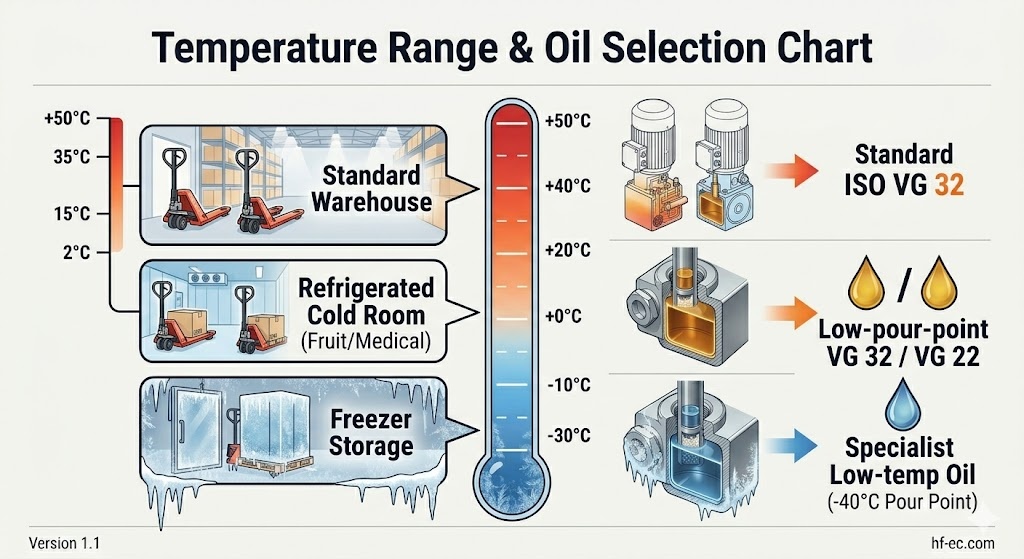
Standard ISO VG 32 hydraulic oil performs well between approximately 0 deg C and 50 deg C. In cold storage environments (2-8 deg C refrigerated; -20 deg C frozen), the oil thickens significantly, causing the same symptoms as using the wrong grade: hard pumping, slow or failed lifting, and increased wear on the pump.
Environment
Temperature
Recommended Oil
Note
Standard warehouse
15-35 deg C
ISO VG 32 (standard)
Per Hangcha specification
Refrigerated (CCT)
2-8 deg C
ISO VG 32 low-pour-point or ISO VG 22
Confirm pour point is rated below 0 deg C; Hangcha cold-spec trucks use this by default
Freezer storage
-20 deg C
Specialist low-temp hydraulic oil (pour point -40 deg C or lower)
Requires purpose-built cold-rated truck; confirm with Hangcha dealer before specifying
An additional issue specific to cold storage: condensation. When a pallet truck moves from a cold room (-20 deg C) to a loading bay (20 deg C), moisture condenses on all surfaces including inside the hydraulic reservoir. Over time this causes water ingress - the milky oil contamination described in Section 3. In cold chain operations, check oil color more frequently (every 2-3 months rather than every 6) and replace at the first sign of cloudiness.
Hangcha cold storage truck note: Hangcha's CBD-series cold storage variants (designated with a cold storage suffix in the model code) are factory-filled with cold-rated hydraulic oil and have seals rated for sustained low-temperature operation. If you are retrofitting a standard truck for cold storage use, the hydraulic oil is one of several components that must be changed - seals, lubrication grease, and battery thermal management also require attention.
7. Hydraulic Oil in the Hangcha Maintenance Schedule
Hangcha's CBD-series maintenance schedules integrate hydraulic oil checks with other periodic maintenance tasks. The intervals below are based on single-shift operation under normal conditions - reduce intervals proportionally for multi-shift or dusty/high-temperature environments.
Interval
Hours
Hydraulic Oil Task
Other Tasks at Same Interval
Daily (D)
Every 8 hr
Visual check for leaks around cylinder base and fill plug
Battery charge; tire and wheel check; fork condition; horn and warning devices
Semiannual (S)
1,000 hr or 6 months
Check oil level and color; top up with ISO VG 32 if needed; inspect for water or contamination
Full hydraulic oil drain and replace; inspect cylinder seals; check relief valve setting
Full truck inspection; fork crack and wear check; load wheel condition; brake adjustment
After run-in
First 50-100 hr (new truck)
Replace hydraulic oil - run-in debris collects in oil during initial break-in period
Check all fasteners for looseness; verify wheel fixing; initial brake adjustment
Frequently Asked Questions
Can I use ISO VG 46 instead of ISO VG 32 in a Hangcha pallet truck?
ISO VG 46 is thicker than specified. In a standard temperature warehouse (15-35 deg C) it will work but the handle will feel stiffer to pump and lifting may be slightly slower. In cold conditions below 10 deg C, VG 46 can cause serious performance problems - sluggish lifting, hard pumping, and increased pump wear as the oil struggles to flow through small-bore passages. Hangcha specifies VG 32 for a reason. If VG 32 is temporarily unavailable, VG 46 is an acceptable short-term substitute in warm environments only. Replace with VG 32 at the next service opportunity.
My pallet jack won't lift after an oil top-up. What went wrong?
Almost certainly air trapped in the hydraulic system during the service. This is the most common post-service issue. The fix: set the control lever to LOWER, then pump the handle 10 to 15 times. This cycles oil through the circuit and purges the air pocket. If the truck still does not lift after bleeding, check that the fill plug is fully tightened (a loose plug allows air to re-enter), then verify the oil level with the forks lowered. If the problem persists, the lowering valve may need adjustment or a seal may be compromised.
How much hydraulic oil does a Hangcha pallet jack hold?
Approximately 0.4 liters (400 ml) on standard manual CBD-series pallet trucks, per the Hangcha operation and maintenance manual. Electric models with larger hydraulic circuits may hold more - check the specific model manual. The reservoir is small by design: pallet jacks only lift a few inches off the ground, so the hydraulic cylinder displacement is minimal compared to a full forklift. Fill to the bottom of the fill plug opening and stop - overfilling causes leaks through the seals when the cylinder extends.
Can I mix different brands of ISO VG 32 hydraulic oil?
Mixing brands of the same ISO grade is generally acceptable in an emergency top-up situation, as long as both oils are mineral-based ISO VG 32 with compatible additive packages. However, mixing is not best practice - different brands use different additive chemistries that can interact unpredictably over time, causing foaming or reduced additive performance. If you need to top up with a different brand, do a full drain and replace at the next scheduled service rather than running the mixed fluid indefinitely. Never mix mineral and synthetic hydraulic oils without verifying compatibility with both manufacturers.
Is biodegradable hydraulic oil suitable for Hangcha pallet trucks?
Biodegradable hydraulic oil - typically ester-based or vegetable oil-based - is suitable if it meets the ISO VG 32 viscosity specification and is compatible with the seal materials in the Hangcha hydraulic unit (NBR / Buna-N rubber is standard). Most modern biodegradable hydraulic oils are formulated to be seal-compatible, but confirm with the oil supplier before use. Biodegradable oil is a sensible choice for food production facilities, environmentally sensitive areas, or pharmaceutical warehouses where spillage risk and contamination concerns are elevated. Do not mix biodegradable and mineral oil - drain completely before switching types.




 عربى
عربى