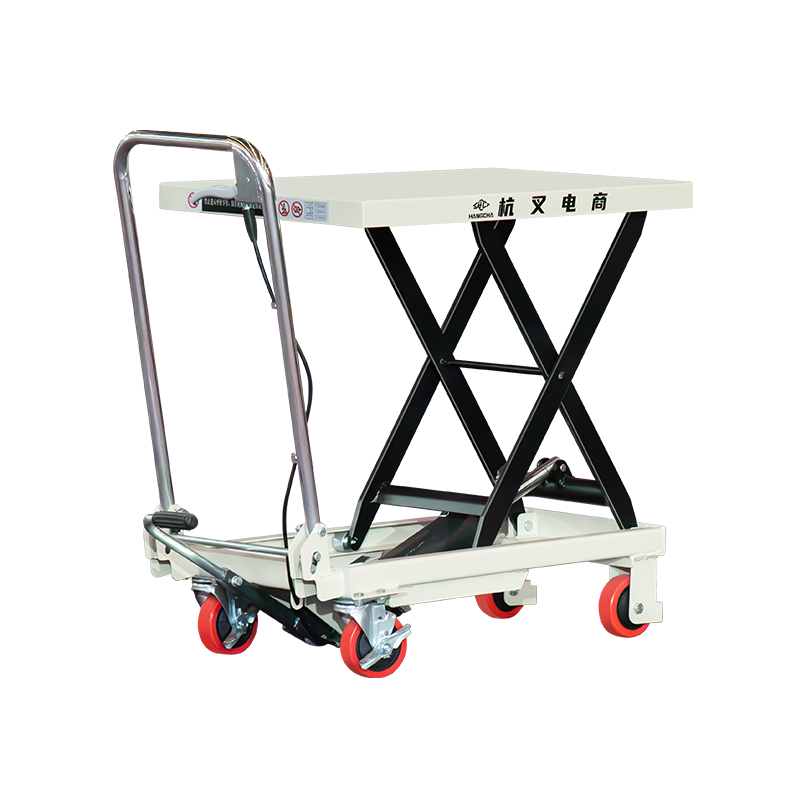
A forklift capacity plate(or data plate, nameplates) tells you the maximum safe load the truck can carry under specific conditions. The three numbers that matter most are: (1) rated capacity in lbs or kg, (2) load center in inches or mm - the distance from the fork face to the load's center of gravity, and (3) maximum lift height. All three work together. Change any one of them and the rated capacity changes too. A 5,000 lb forklift does not always lift 5,000 lb - read every line of the plate before you load.
The capacity plate - also called a data plate, nameplate, or weight plate - is a metal tag permanently mounted on every forklift, typically on the dashboard or front mast upright where the operator can see it from the seat. It is not a suggestion. Under OSHA 29 CFR 1910.178(a)(6), every forklift must carry a durable, corrosion-resistant nameplate that is legible at all times. Operating a forklift with a missing, damaged, or illegible plate is a citable OSHA violation.
The plate is installed by the manufacturer and verified by a nationally recognized testing laboratory (NRTL) such as UL or FM. Per ANSI/ITSDF B56.1, the capacity listed is the result of either a physical tilt-table test or an engineered calculation covering the truck's worst-case stability envelope. It is not an estimate - it is a tested, certified limit.
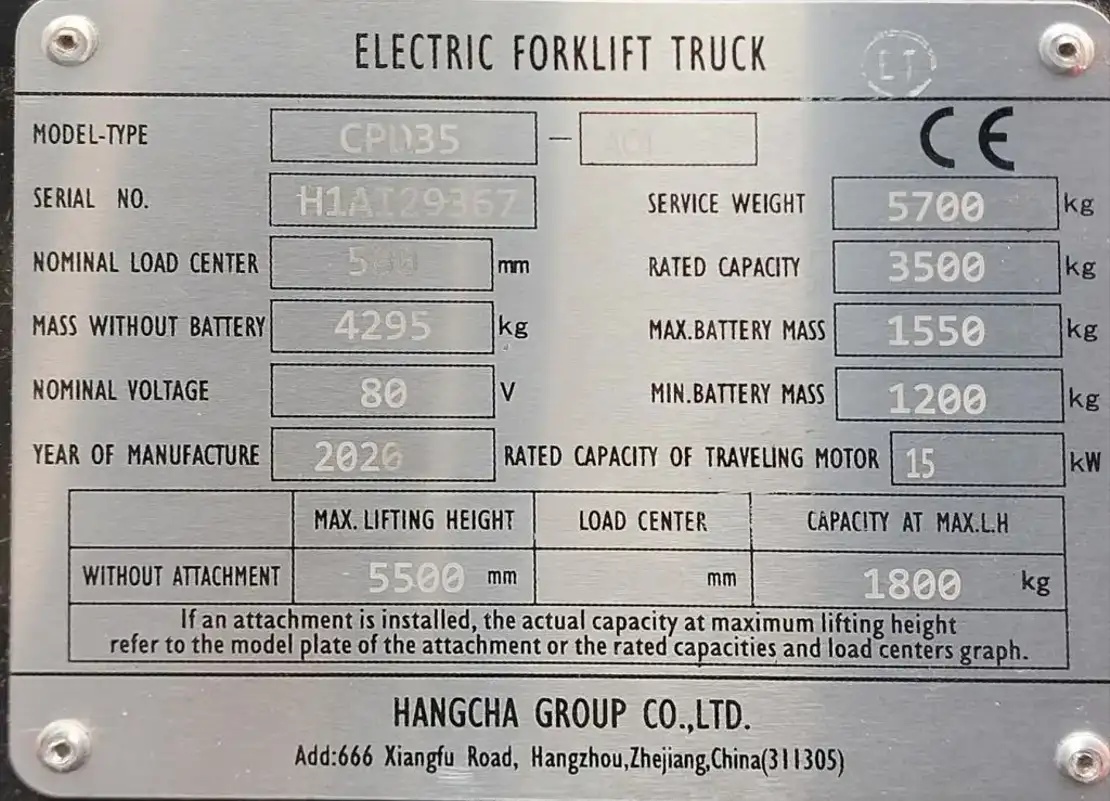
Capacity plates vary slightly by manufacturer and truck type, but OSHA and ANSI mandate a set of core fields that must always appear. Here is every field, what it means, and why it matters:
| Field | What It Tells You | Common Mistake |
|---|---|---|
| Truck type designation e.g. E, G, LP, DS, EX |
Power source and hazardous-area rating. E = electric; G = gasoline; LP = liquid propane; DS = diesel; EX = explosion-proof rated | Assuming any electric truck is safe in classified hazardous areas - only EX-rated trucks are approved |
| Rated capacity | The maximum load the truck can lift safely - but only at the stated load center and lift height. It is not an absolute ceiling independent of those conditions | Treating rated capacity as a fixed number regardless of load position or height |
| Load center | The horizontal distance from the front face of the forks to the center of gravity of the load. Standard is 24 in (600 mm). The rated capacity is only valid at this exact distance | Not accounting for loads wider than 48 in - their center of gravity sits beyond 24 in, reducing effective capacity |
| Maximum lift height | The height to which the stated capacity applies. As lift height increases, residual capacity decreases - a separate residual capacity chart on the mast shows this relationship | Assuming full rated capacity still applies when lifting to 4m+ in a high-rack warehouse |
| Truck weight (service weight) | The weight of the truck itself, including battery for electric models. Critical for floor load calculations and elevator capacity planning | Forgetting that a loaded forklift on an elevator = truck weight + load weight. Combined weight can exceed elevator ratings |
| Battery weight (min/max) | Electric trucks only. The counterweight function is partly performed by the battery - if a lighter battery is installed, rated capacity is invalidated and must be recalculated | Swapping to a smaller/lighter battery without updating the capacity plate |
| Mast type | 2-stage, 3-stage, 4-stage, or full free lift. Determines how the truck lifts and at what height visibility is restricted. Capacity at full height depends on mast type | Replacing a mast without recertifying the capacity plate |
| Attachment (if installed) | Any non-factory attachment (side-shifter, clamp, drum handler) adds weight and shifts the load center forward, reducing capacity. A second line on the plate shows revised capacity with the attachment installed | Using base rated capacity when an attachment is fitted - the lower attachment capacity line applies |
| NRTL approval mark | Confirmation that a nationally recognized testing laboratory (UL, FM, CSA) has verified the specifications. Required by OSHA 29 CFR 1910.178(a)(3) | Accepting a replacement plate from an uncertified source |
Load center is the single most misunderstood concept in forklift operation. The rated capacity on the plate assumes the load's center of gravity sits exactly at the stated load center distance from the fork face - typically 24 inches (600 mm). This corresponds to a standard 48-inch-deep pallet with evenly distributed weight.
Move the load center further out - because the load is deeper, heavier on one side, or because an attachment pushes the load forward - and the truck becomes less stable. The effective safe capacity drops. The plate number does not change. Your margin of safety does.
The relationship is roughly proportional. Use this formula to estimate adjusted capacity when your load center differs from the plate value:
| Actual Load Center | 5,000 lb truck (rated at 24 in) | Capacity Remaining | Typical Scenario |
|---|---|---|---|
| 24 in (600 mm) | 5,000 lb | 100% | Standard 48 x 40 in pallet, even load |
| 30 in (762 mm) | 4,000 lb | 80% | 60-in deep pallet or front-heavy load |
| 36 in (914 mm) | 3,333 lb | 67% | 72-in deep load or attachment adding reach |
| 48 in (1,219 mm) | 2,500 lb | 50% | 96-in load or large drum clamp extended |
The rated capacity on the plate applies at a specific lift height - usually ground level or a low travel height. As the mast extends upward, two things happen that reduce safe capacity: the truck's center of gravity rises, and the forward leverage on the front axle increases. This is called residual capacity - the actual usable capacity at a given height.
Residual capacity is shown on a separate chart mounted on the mast, not on the capacity plate. In high-rack warehouses - the most common setting where this matters - operators who read only the capacity plate and ignore the residual chart are operating blind at their most dangerous moments.
The practical implication: a 5,000 lb rated forklift placing pallets on a 20-foot rack may only safely handle 2,500-2,800 lb at that height. If your loads weigh 4,000 lb and you are stacking them at 20 feet, you are operating beyond safe limits every time - and the capacity plate gave you the right number. You just did not read the mast chart too.
Any non-factory attachment fitted to a forklift - side-shifter, rotator, clamp, drum handler, push-pull, single-double - has two effects on rated capacity:
Under OSHA 29 CFR 1910.178(a)(5) and ANSI B56.1, every attachment requires written manufacturer approval before installation. Once approved, the capacity plate must be updated to show the combined weight of truck and attachment, and the revised capacity at maximum elevation with the attachment installed.
| Attachment Type | Typical Weight | Typical Capacity Impact | Plate Update Required |
|---|---|---|---|
| Side-shifter | 200-350 lb | -300 to -500 lb on rated capacity | Yes |
| Rotating clamp | 500-900 lb | -800 to -1,500 lb | Yes |
| Single-double (fork spreader) | 300-500 lb | -500 to -1,000 lb (plus load center change) | Yes |
| Drum handler | 150-400 lb | -300 to -600 lb | Yes |
| Extended forks (beyond factory length) | Varies | Significant - load center shifts proportionally to fork extension | Yes |
The truck type designation on the capacity plate is not just a fuel identifier. It is a safety classification defined by OSHA and ANSI that determines where the truck is legally permitted to operate based on environmental hazards.
| Code | Power Source | Hazardous Area Rating | Typical Use |
|---|---|---|---|
| E | Electric | General (non-classified) areas | Standard warehouses, finished goods storage |
| ES | Electric | Areas where flammable vapors may exist in minor quantities | Facilities with occasional solvent use |
| EE | Electric | Areas with moderate flammable vapor or dust risk | Grain handling, certain chemical storage |
| EX | Electric | Classified hazardous locations (NEC Class I/II Div. 1) | Pharmaceutical API areas, solvent storage, paint facilities |
| G | Gasoline | General (outdoor or well-ventilated areas) | Lumber yards, outdoor construction, loading docks |
| LP / LPS | Liquid propane | LP = general; LPS = some classified area protection | Food distribution, cold storage loading docks, outdoor yard |
| D / DS / DY | Diesel | D = general; DS / DY = additional safeguards | Heavy outdoor operations, ports, construction sites |
The capacity plate is a living document. Any change to the truck that affects capacity, weight distribution, or safe operation requires a plate update - and written manufacturer approval before that change is made. This is not optional under OSHA or ANSI.
| Change | Plate Update Required | Manufacturer Approval Required |
|---|---|---|
| Adding a non-factory attachment (side-shifter, clamp, etc.) | Yes | Yes - written approval required first |
| Replacing the battery with a different weight | Yes | Yes if outside min/max range on plate |
| Replacing the mast with a different type or height | Yes | Yes |
| Extending or lengthening the forks | Yes | Yes |
| Modifying the counterweight | Yes | Yes - and rarely granted |
| Routine maintenance (oil, filters, tires of same spec) | No | No |
If the original manufacturer is out of business or unresponsive, OSHA allows a Qualified Registered Professional Engineer to perform the safety analysis and approve the modification in writing. The plate must still be updated before the truck returns to service.
A forklift without a legible capacity plate must be taken out of service immediately. This is not a judgment call - it is a direct OSHA requirement under 29 CFR 1910.178(a)(6).
Steps to follow:
Before every shift, operators should run through this sequence:

+86-0571-88131206

+86-19084200370

+86-17816721301
 عربى
عربى