عربى
عربى
A comprehensive SOP and operational guide for fleet managers, warehouse supervisors, and industrial battery technicians across North American material handling operations.
1. When to Add Water: Timing vs Charging and Equalization
In flooded lead-acid forklift batteries, precise watering timing is fundamental to preventing thermal runaway, plate oxidation, and premature cell death. The absolute golden rule of industrial battery maintenance is simple: Always water after charging and proper cooling, never before—with very few specific exceptions.
During normal discharge, electrolyte active fluid (sulfuric acid) penetrates the porous lead plates, forming lead sulfate and lowering the liquid level. As the battery undergoes its charging cycle, water molecules electrolyze into hydrogen and oxygen gas while acid is pushed out from the plates back into the solution. This process causes the liquid volume within each cell to naturally expand. If top-off water is added prior to initiating a charge, the subsequent volumetric expansion causes the acid-water solution to overflow the vent caps, resulting in severe acid boil-over, localized loss of active specific gravity, and structural corrosion of the steel battery tray.
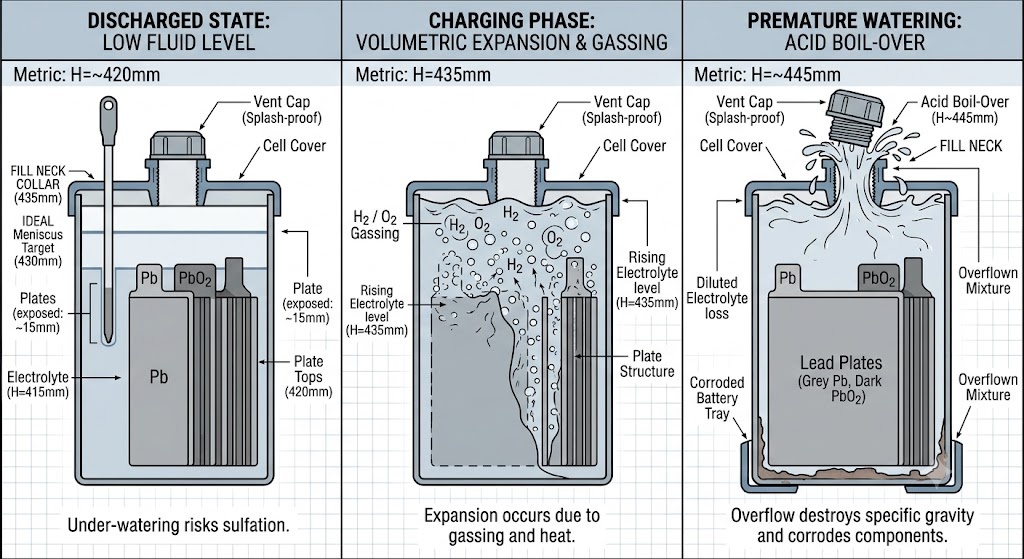
Recommended Rest & Cool-Down Intervals
Following a standard 8-hour charge cycle, the battery interior temperature routinely exceeds 100 degrees F (38 degrees C). Fleet technicians must strictly enforce a minimum cool-down window of 2 to 4 hours post-charge prior to checking or adding water. Water top-offs should ideally occur when cell temperatures stabilize below 90 degrees F (32 degrees C).
Equalization Charging Exception: An equalization charge is a controlled deliberate overcharge designed to eliminate acid stratification and balance cell voltages across the string. Equalization generates aggressive gassing, which consumes significant water volume. The optimal watering window is immediately after the equalization charge has completed and cooled for 3 to 4 hours. Watering before an equalization cycle virtually guarantees acid spillover due to prolonged fluid expansion.
Pre-charge Exception Rule: The only acceptable scenario for adding water prior to charging is when cell plates are completely exposed to open air (dry plates). Exposed plates oxidize rapidly upon contact with oxygen, permanently destroying active lead material. In this emergency scenario, add just enough distilled water to submerge the plate tops by approximately 1/16 inch (1.5 mm), complete the full charge cycle, allow the cool-down period, and then conduct a complete fluid top-off to the operational fill-to line.
Note: This guide applies exclusively to standard flooded (wet cell) lead-acid batteries. Valve-Regulated Lead-Acid (VRLA), Absorbed Glass Mat (AGM), Gel, and Lithium-Ion forklift power units are sealed or maintenance-free systems that must never be opened or watered. Always cross-reference your specific Original Equipment Manufacturer (OEM) service manuals (such as Crown, Toyota, Hyster-Yale, or Raymond) for warranty compliance.
2. How to Check Electrolyte Levels and Exactly How Much Water to Add
Achieving exact fluid height across all cells requires structured visual inspection techniques and adherence to strict metric and imperial fluid tolerances. Misjudging electrolyte level leads either to plate sulfation from under-filling or acid dilution from over-filling.
Each cell is equipped with a splash-proof vent cap and a fill neck (basket). Inside the neck, manufacturers mold a physical indicator ring known as the "fill-to line" or splash tube basket edge. When fully topped off, the electrolyte meniscus should touch the lower rim of this plastic collar, remaining approximately 1/4 inch to 3/8 inch (6 mm to 10 mm) below the top edge of the cell cover.
| Electrolyte Level State | Imperial Tolerance | Metric Tolerance | Operational Action Required |
|---|---|---|---|
| Critical Low (Plate Exposure) | Below plate top edge | Below plate top edge | Emergency top-off (1/16 in / 1.5 mm above plates), then charge immediately. |
| Acceptable Low | 1/8 in to 1/4 in above plates | 3 mm to 6 mm above plates | Safe to operate; schedule routine post-charge watering. |
| Optimal Operational Target | 1/4 in below bottom of fill neck collar | 6 mm below bottom of fill neck collar | Ideal target level reached. Stop adding water. |
| Over-Filled Condition | Touching cap seating thread / overflowing | Above collar slot base | Excess liquid must be siphoned with a manual acid syringe. |
Water Volume Estimations: On average, a standard 18-cell 36V 850 Ah industrial battery consumes approximately 0.5 to 1.2 liters (17 to 40 fl. oz.) of water per cell every 10 to 15 charge cycles under normal operating conditions. A practical rule of thumb is approximately 1.0 to 1.5 milliliters of pure water consumed per Ampere-hour (Ah) discharged per cell cycle.
Water Purity Requirements: Never use tap water, well water, or standard bottled spring water. Tap water contains dissolved minerals (calcium, iron, chlorine, nitrates) that permanently contaminate active chemical paste. Iron content as low as 0.0004 percent causes rapid self-discharge. Only use steam-distilled or deionized water with a maximum electrical conductivity of less than 10 micro-Siemens/cm (or total dissolved solids less than 5 ppm).
Navigating Complex Inspection Conditions: In heavy-duty operations where electrolyte mist creates turbidity or when inspecting batteries with safety-capped flip-top vents, accurate visual checks become difficult. Technicians should utilize an insulated LED sight gauge flashlight or a non-conductive plastic dipstick calibrated with notch marks at 1/4 inch increments. To avoid splashing or overfilling, low-flow fill valves operating between 2 and 5 PSI (0.14 to 0.34 bar) must be used.
- Class I Electric Counterbalance (48V / 750Ah): High thermal mass. Requires 0.8 L to 1.5 L water per cell during weekly service.
- Class II Stand-up Reach Trucks (36V / 600Ah): High pulse currents create accelerated evaporation. Inspect every 5 to 7 cycles; expect 0.4 L to 0.8 L per cell.
- Class III Electric Pallet Jacks (24V / 330Ah): Smaller reserve capacity. Top-off typically requires 0.15 L to 0.35 L per cell every 10 to 14 days.
3. Recommended Watering Frequency: Schedules Tied to Usage, Temperature, and Charge Cycles
Arbitrary "water every Friday" rules fail because water loss is a direct physical variable of electrical work performed and ambient thermal stress. Fleet operations should establish quantitative watering schedules based on operational intensity tiers.
Maintenance Cadence: Every 10 to 14 calendar days (or every 8 to 10 charge cycles). Recommended for seasonal distribution hubs or back-of-store retail operations.
Maintenance Cadence: Weekly (Every 5 to 7 charge cycles). Recommended for standard manufacturing assembly lines and general logistics facilities.
Maintenance Cadence: Bi-weekly or every 3 to 4 days (Every 3 to 5 full charge equivalents). Fast charging elevates continuous core temperature, accelerating gassing rates by up to 250 percent.
Temperature Multiplier Factors: Ambient operating temperatures severely alter water evaporation rates. Use the following operational formula to adjust standard calendar watering intervals under extreme environmental conditions:
- Cold Storage / Refrigerated Warehouses (32 degrees F / 0 degrees C): TCF = 1.4 to 1.6 (Chemical reaction slows down; lower gassing rate, longer watering interval).
- Standard Ambient Warehouse (68 - 77 degrees F / 20 - 25 degrees C): TCF = 1.0 (Standard baseline interval).
- Hot Summer Outdoor Yards / Non-AC Warehouses (over 95 degrees F / 35 degrees C): TCF = 0.5 to 0.6 (High thermal ambient accelerates chemical evaporation; double the watering frequency).
Measurable Failure Metrics & Financial Impact: Neglecting fluid levels directly impacts fleet profitability. When electrolyte falls 1/2 inch (12.7 mm) below the top of the plates, the exposed lead oxide suffers irreversible hard sulfation within 48 hours. This reduces nominal usable battery capacity by 15 percent to 30 percent permanently within 3 months, shortening a typical 5-year battery life span down to under 3 years. Conversely, over-watering leads to acid boil-over during charging, reducing electrolyte specific gravity from the ideal 1.280 - 1.290 baseline down to under 1.210, reducing daily runtime by 20 percent and requiring costly acid adjustment washes.
4. Safety, PPE, Spill Response, and Regulatory Compliance Notes
Industrial forklift batteries contain concentrated sulfuric acid solution (30% to 40% H2SO4) capable of causing severe chemical burns, irreversible blindness, and acute toxic exposure. Strict adherence to North American workplace safety standards is legally mandatory.
Required Personal Protective Equipment (PPE) Checklist
- Eye/Face Protection: ANSI Z87.1 approved full-face shield combined with indirect-vent chemical splash goggles.
- Hand Protection: Heavy-duty, high-cuff neoprene or nitrile gloves (minimum thickness 14 mil) extending past the wrist.
- Body Protection: Acid-resistant rubberized apron and fluid-impermeable safety boots (steel toe with chemical shield).
- Emergency Facilities: An OSHA-compliant eyewash station capable of providing 15 minutes of continuous flushing within 10 seconds of travel time (29 CFR 1910.151(c)).
Acid Spill Emergency Protocol
- Evacuate non-essential personnel and ensure proper area ventilation (H2 gas hazard).
- Apply commercial acid-neutralizing compound (e.g., Sodium Bicarbonate / Baking Soda or color-indicating neutralizing agent) starting from the outer perimeter moving inward until fizzing stops.
- Verify complete neutralization (pH target between 6.0 and 9.0) using test strips.
- Absorb neutralized liquid with polypropylene sorbent pads and place into hazardous waste disposal drums.
- Report spills exceeding 100 lbs (approx. 10 gallons of electrolyte) to EPA federal guidelines under CERCLA requirements.
Regulatory Compliance Summary: OSHA Standard 1910.178(g) mandates that battery maintenance and watering must be conducted only by trained, designated personnel. Employers are required to maintain signed training logs demonstrating annual refresher certifications and retain weekly watering inspection records for a minimum of 12 months for compliance auditing.
5. Tools, Automation, Maintenance Logs, and Cost/ROI Analysis
Transitioning from manual jug-filling to automated single-point watering systems (SPWS) significantly increases fleet operational efficiency, eliminates human error, and extends asset service life.
Tooling Comparison: Manual vs Automatic Systems
Manual watering relies on gravity jugs or manual squeeze pumps equipped with rubber nozzles. This method takes 12 to 20 minutes per battery and exposes technicians directly to open vent ports and acid fumes. Single-Point Automatic Watering Systems (SPWS) utilize permanently installed cell manifolds with internal displacement shut-off valves connected via quick-disconnect couplers to a pressurized water supply (gravity feed or electric pump wagon). Filling time drops to under 60 seconds per battery with absolute level accuracy.
Financial ROI Calculation: 20-Forklift Fleet Fleet Model (US Operations)
| Metric / Cost Category | Manual Watering Method | Single-Point Auto Watering System |
|---|---|---|
| Initial Hardware & Tooling Cost | $250 (Jugs, manual pumps, safety PPE) | $5,600 ($250/kit * 20 + $600 cart pump) |
| Labor Time per Battery / Week | 15 minutes (0.25 hours) | 1 minute (0.016 hours) |
| Annual Labor Hours (20 Units, 52 Weeks) | 260 labor hours | 17 labor hours |
| Annual Labor Cost ($30/hr fully loaded) | $7,800 per year | $510 per year |
| Annual Direct Labor Savings | $0 | $7,290 per year |
| System Payback Period | N/A | Approx. 9.2 Months |
In addition to labor savings, extended battery lifespan (saving $4,500 replacement costs per battery every two years) yields a total 3-year Return on Investment (ROI) exceeding 320 percent for medium-to-large warehouse facilities.
Forklift Battery Maintenance & Watering Log (SOP Sample Template)
Post this form directly on battery charging station boards. Retain completed monthly logs for OSHA/Warranty audit records.
| Date | Truck / Battery ID | Charge & Cool Complete? | Water Added? (Gal/L) | Purity Verified (<10uS)? | Tech Initial |
|---|---|---|---|---|---|
| MM/DD/YY | BAT-36V-014 | [ ] YES [ ] NO | ______ Gal | [ ] PASS [ ] FAIL | ______ |
| MM/DD/YY | BAT-48V-008 | [ ] YES [ ] NO | ______ Gal | [ ] PASS [ ] FAIL | ______ |
| MM/DD/YY | BAT-24V-022 | [ ] YES [ ] NO | ______ Gal | [ ] PASS [ ] FAIL | ______ |
Optimize Your Fleet's Battery Lifespan & Reduce Downtime Today
Proper battery watering prevents premature replacement, eliminates expensive acid spill cleanups, and ensures maximum shift productivity. Take the next step toward automated, compliant fleet care.
Frequently Asked Questions (FAQ)
Should I add water to a forklift battery before or after charging, and why?
Always add water after charging and proper cooling. During the charging process, the electrolyte solution expands in volume due to thermal expansion and gas generation. If you water prior to charging, the expanding liquid will overflow vent caps, causing dangerous acid spills and permanent loss of battery power capacity. The only exception is if battery plates are dry and exposed before charging; in this case, add just enough water to submerge the plates before initiating the charge.
How often should I water a forklift battery based on usage, amp-hours, or charge cycles?
Watering frequency depends directly on battery work volume. Single-shift light applications (under 1,000 Ah/week) require watering every 10 to 14 days. Double-shift medium applications require weekly checks. High-intensity 3-shift fleets or fast-charging setups require watering every 3 to 5 charge cycles (or twice weekly). A general rule of thumb is inspecting cells every 5 to 10 full charge cycles.
How long can reach trucks go between waterings under light, medium, and heavy use?
Stand-up reach trucks (Class II) generate high thermal cycles due to frequent hydraulic lifting. Under light usage, reach trucks can go 10 to 12 days between waterings. Under medium usage, they require top-offs every 5 to 7 days. Under heavy multi-shift distribution usage, reach truck batteries require fluid inspection every 3 to 4 days.
What causes a forklift battery to require watering every 10 days, and when is that normal?
Requiring water every 10 days is perfectly normal for standard medium-duty single-to-two-shift warehouse operations operating in moderate ambient temperatures (65-80 degrees F). However, if a lightly used battery suddenly requires water every 10 days, potential causes include an aging battery nearing end-of-life, overcharging caused by faulty charger voltage regulation, excessive ambient heat, or degraded cell separators causing high internal current leakage.
What are the measurable signs of under-watering or over-watering a flooded lead-acid battery?
Under-watering causes visible white lead sulfate crystals on exposed plate tops, rapid temperature spikes during operation, a strong sulfur odor, and permanent capacity loss (shortened daily runtimes). Over-watering causes wet battery tray tops, white acid powder accumulation on cell terminals, corroded tray steel, and low hydrometer specific gravity readings (below 1.210) due to acid dilution.
Are automatic watering systems worth the cost for a US warehouse fleet, and how do they compare to manual watering?
Yes. For fleets with 5 or more forklifts, Single-Point Watering Systems (SPWS) offer a payback period of under 10 months. SPWS reduces per-battery watering time from 15 minutes down to under 1 minute while preventing human overfilling errors. For a 20-forklift fleet, SPWS saves over $7,000 annually in direct technician labor costs alone while extending overall battery service life by 1 to 2 years.