Forklifts are the backbone of modern material handling, and in many demanding industrial environments, no machine commands respect quite like the diesel forklift.
These powerful trucks, driven by Internal Combustion (IC) engines, are the industry’s heavy-duty powerhouse. From the bustling activity of a shipping port to the rugged landscape of a construction site, diesel-powered forklifts are specifically engineered for relentless use, high tonnage, and all-weather operation. They are not merely for lifting; they are for moving the world's heaviest freight—containers, steel beams, massive coils, and lumber—with unwavering reliability.
Diesel forklifts are often first categorized by their lifting capacity, which dictates the type of work they are best suited for. This is a fundamental metric that every business must define before making a purchase. We can generally divide them into three power classes:

These compact and agile diesel models are essential for operations that involve heavy-duty, yet intermittent, material movement in mid-sized commercial yards, workshops, and outdoor warehouse staging areas.
Primary Use: Handling single or double pallets, loading and unloading light to medium delivery trucks, and general transportation across a facility.
Key Advantage: They offer the raw power and quick refueling of a diesel engine in a footprint small enough for maneuverability in smaller yards and tighter spaces where an electric truck might struggle with power requirements.
The 3-to-5-ton range represents the most common class of diesel forklifts sold globally. They strike the perfect balance between power, size, and cost.
Primary Use: Manufacturing plants, lumberyards, major distribution centres, and heavy-duty general applications. They can comfortably handle large, dense loads for extended periods.
Key Advantage: They are highly versatile, capable of performing everything from stacking heavy materials to loading standard shipping containers.
When the loads become colossal, you need a heavy-duty diesel forklift. These are specialized machines designed for maximum lifting capacity, often featuring massive frames and powerful, high-torque engines.
Primary Use: Container stacking at ports and terminals, handling steel or concrete products, loading heavy machinery, and working in extreme industrial environments like scrap yards or heavy pipe manufacturing.
Key Advantage: Their sheer power and robust construction allow for the continuous handling of tens of thousands of pounds, often with specialized attachments, making them indispensable in the world’s most demanding material handling environments.
The ground you operate on is arguably the single most important factor in choosing a diesel forklift. The right tire type ensures stability, traction, and operator comfort, while the wrong one can lead to costly downtime and maintenance.
Diesel forklifts primarily utilize two types of tires, which align with the official OSHA/ITA classifications for Internal Combustion (IC) trucks:
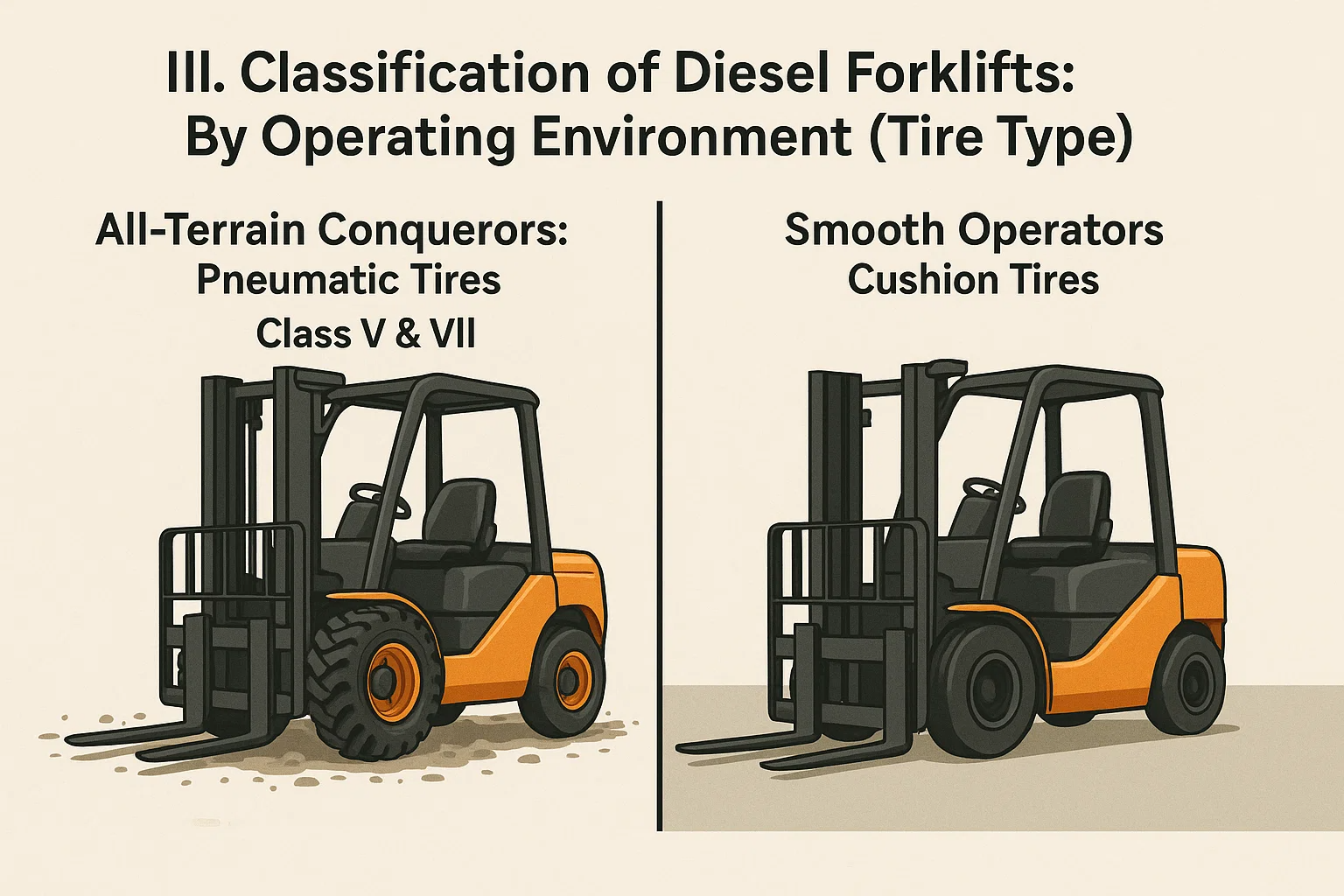
Pneumatic tires are similar to the air-filled tires you find on cars, but they are built with exceptionally deep treads and reinforced rubber, offering superior grip and shock absorption. These models fall under Class V (standard IC trucks) and Class VII (Rough Terrain trucks).
Features: Air-filled, aggressive tread patterns, and high ground clearance.
Best for: Outdoor use on surfaces that are uneven, wet, muddy, or covered in gravel and dirt. They provide excellent stability and a smoother ride across obstacles.
Ideal Applications: Construction sites, lumberyards, farming operations, and any general outdoor storage or manufacturing facility. Choosing a pneumatic tire forklift is non-negotiable for working in the great outdoors.
Cushion tires are made of solid rubber and are mounted directly onto the wheel hub. They provide stability and a solid base, but they lack the shock absorption of pneumatic tires. These trucks fall under Class IV.
Features: Solid rubber construction, little to no tread, and a compact chassis with lower ground clearance.
Best for: Indoor use on smooth, dry surfaces like concrete floors. The lower profile allows the forklift to operate in tighter spaces and often has a smaller turning radius.
Ideal Applications: Indoor warehouses, container stuffing/de-stuffing, and industrial facilities with strictly defined travel paths. While diesel is less common indoors due to emissions, a Class IV model with cushion tires is used when raw diesel power is required on smooth floors or docks.
| Tire Type | Operating Environment | Key Characteristic |
| Pneumatic | Outdoor, Rough/Uneven Surfaces | Excellent shock absorption and traction |
| Cushion | Indoor, Smooth/Flat Surfaces | Compact size and minimal rolling resistance |
The mast is the vertical assembly on the front of the forklift that does the actual heavy lifting. Choosing the right mast type directly impacts your maximum lift height and your ability to operate in areas with height restrictions, such as loading docks or drive-through racking.
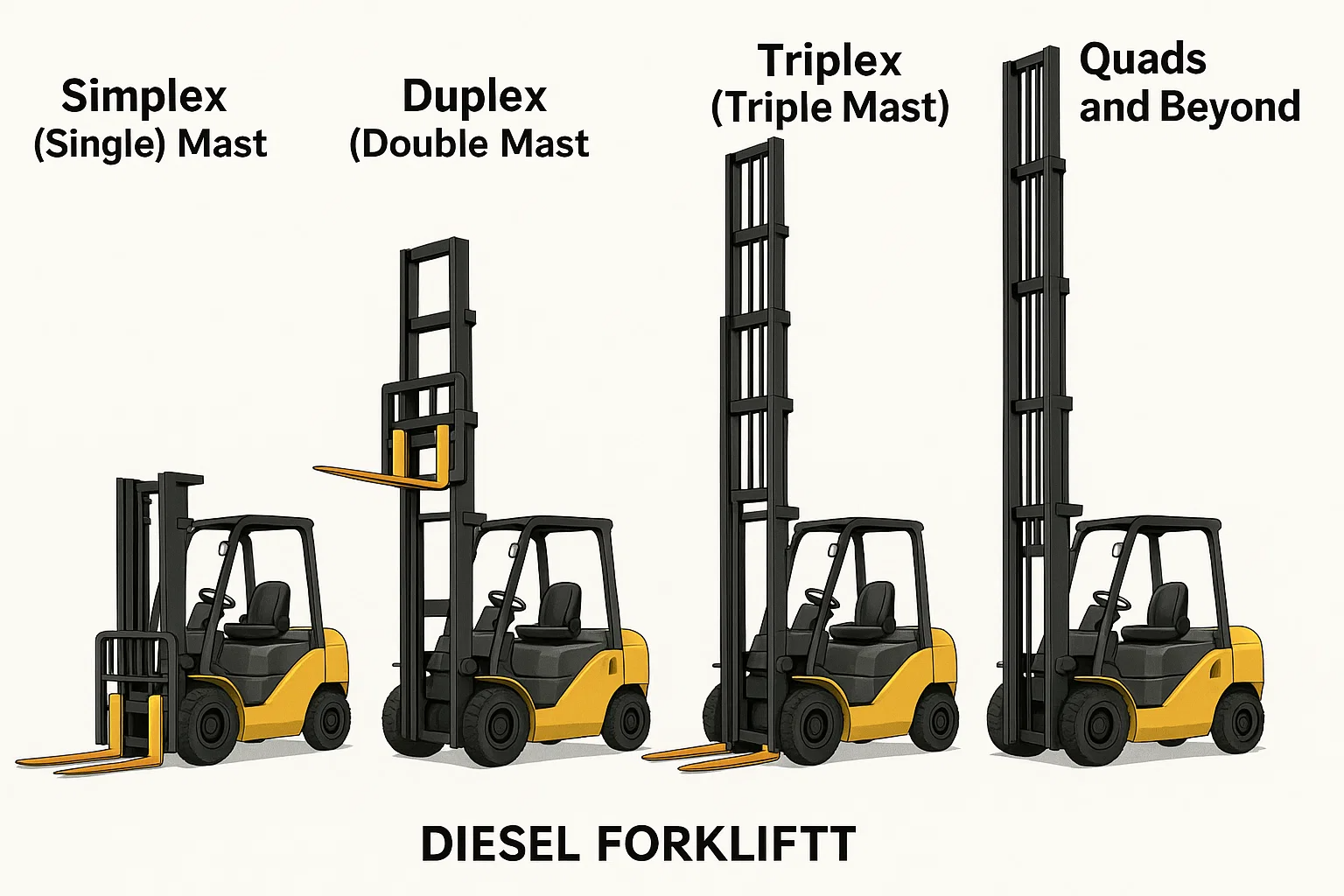
Design: A single-stage mast with one fixed rail. The fork carriage moves up the rail to lift the load.
Key Advantage: Simplicity and reliability. They are ideal when the lift height is limited and are perfect for applications with low overhead clearance, such as driving through standard doorway openings or into the back of a container.
Design: A two-stage mast with an inner rail that extends inside an outer rail.
Key Advantage: It allows for greater lifting height than a simplex mast while maintaining a relatively low collapsed height.
Design: A three-stage mast that uses two sets of extending rails and a central hydraulic cylinder.
Key Advantage: This is the most common mast in many high-stacking environments. It offers an excellent combination of high maximum lift and a relatively compact collapsed height, making it highly versatile for both stacking and container work.
Design: A four-stage mast, offering the maximum number of telescoping sections for the highest possible vertical reach.
Key Advantage: Quad masts are used in specialized applications where reaching extreme heights is necessary for high-density storage. They provide the ultimate vertical lift for facilities utilizing very high racking systems.
| Mast Type | Number of Stages | Primary Application |
| Simplex | Single | Low-clearance doors/ceilings |
| Duplex | Two | Good balance of lift and collapsed height |
| Triplex | Three | Standard for high-stacking and versatility |
| Quad | Four | Extreme high-reach requirements |
Beyond their mechanical components, diesel forklifts can be classified by their specialized design features built to tackle unique industrial challenges.
These machines are the true outdoor specialists, almost always diesel-powered due to the environments they face. They are distinguished by their beefed-up chassis, powerful four-wheel drive systems, high ground clearance, and massive pneumatic tires.
Key Feature: Their rugged design allows them to navigate unpaved construction sites, muddy terrain, and gravel pits while maintaining stability and load integrity.
Use Case: Lifting and transporting lumber, bricks, steel beams, and heavy materials across active building sites. They embody the essence of the construction forklift.
Found in shipping yards and ports, these are the heavy-duty forklift models that demand the greatest lifting capacity.
Key Feature: They possess massive counterweights and often feature specialized spreaders or attachments designed to lock onto and stack full-sized shipping containers (up to 40 feet long) multiple layers high.
Use Case: The non-stop loading, unloading, and stacking of freight containers and extremely dense, heavy cargo.
While this is a general design, the diesel counterbalance is arguably the most common and versatile industrial truck.
Key Feature: The machine uses a heavy weight integrated into its rear section to counteract the weight of the load being lifted by the forks, allowing it to move directly up to a load without outriggers.
Use Case: Excellent for general-purpose heavy-lifting in wide-open yards, large manufacturing floors, and loading/unloading goods vehicles efficiently.
A diesel forklift is a sophisticated piece of equipment. Evaluating these key features is essential for optimizing performance and protecting your most valuable assets—your people and your products.
Modern diesel engines in forklifts are designed for maximum power density and surprising fuel efficiency, but they must also comply with rigorous government mandates.
Common Engine Specifications: Diesel engines are valued for their consistent high torque, which translates directly into lifting power and the ability to operate continuously at high capacity.
Striking the Balance: Fuel Economy and Emissions Compliance (EPA Tier 4): Any new diesel forklift must meet stringent emissions standards, primarily the EPA's Tier 4 regulations (or equivalent global standards). This requires advanced technologies like:
Diesel Particulate Filters (DPF): Traps soot and particulate matter.
Selective Catalytic Reduction (SCR): Uses Diesel Exhaust Fluid (DEF/urea) to convert harmful nitrogen oxides (NOx) into harmless nitrogen and water. Choosing a Tier 4 compliant engine ensures you meet legal mandates and are investing in the cleanest, most efficient diesel technology available.
Forklift safety is paramount, and modern diesel units are equipped with sophisticated safety systems designed to protect the operator and nearby personnel.
Operator Presence Systems (OPS): These systems are critical. If the operator is not correctly seated and buckled in, the OPS will typically lock out key functions like lifting, lowering, or driving, preventing accidental movement.
Load Sensing Systems: Prevents dangerous lifting capacity overload by alerting the operator or restricting mast movement if the load exceeds the truck's rated capacity (often based on the load's distance from the mast, or "load center").
Visibility Enhancements: Safety standards require features like overhead guards, but modern additions include blue warning lights (projecting a blue spot on the floor to warn pedestrians of an approaching vehicle) and mandatory horns and reverse alarms.
Operator Restraints: OSHA and safety bodies mandate the use of seatbelts to protect the operator from being ejected or pinned in the event of a lateral tip-over.
A tired, uncomfortable operator is a less safe and less productive one. Ergonomics in a diesel forklift are focused on minimizing fatigue during long shifts.
Adjustable Seating and Controls: Modern designs prioritize adjustable steering columns, full-suspension seats to absorb bumps (especially important on pneumatic tire models), and intuitive, low-effort hydraulic controls.
Reduced Vibration and Noise: While diesel engines are inherently louder than electric, manufacturers use sound-dampening materials and isolated mounting to minimize noise and vibration transmitted to the operator.
Diesel forklifts are durable, but they require diligent forklift maintenance to maintain performance, emissions compliance, and longevity.
Routine Maintenance Tasks: Adhering to the manufacturer’s schedule is vital. This includes regular oil and filter changes, checking fluid levels (engine oil, coolant, DEF), and inspecting the air intake system.
Inspecting Critical Components: Daily pre-shift inspections (OSHA requirement) should cover: the condition of the tires, the integrity of the mast type and chains, and the proper function of all brakes, lights, and horns.
Managing Emissions Systems: The DPF and SCR systems need periodic maintenance, often involving cleaning or replacing the DPF to ensure the engine remains compliant and fuel-efficient. Neglecting this can lead to costly engine issues and regulatory fines.
Choosing the right diesel forklift is a strategic business decision that balances upfront cost, reliability, maintenance, and long-term operating efficiency.
The diesel forklift market is dominated by a few major players known for their durability, global support networks, and advanced technology.
| Brand | Noteworthy Characteristic (Diesel Focus) | Key Advantage |
| Toyota | Global leader in reliability, leveraging automotive engineering. | High resale value, excellent safety technology (SAS - System of Active Stability), extensive dealer network. |
| Hyster / Yale | Known for robust, heavy-duty machines and high-capacity handlers. | Exceptional durability and power, often preferred for rough terrain and port applications. |
| Caterpillar (CAT) | Leverages its reputation in heavy construction equipment. | Rugged build quality, strong global service and parts support, suitable for demanding environments. |
| Linde | European leader, known for high-quality engineering. | Innovative hydrostatic drive systems for smooth power transfer and reduced component wear, prioritizing ergonomics. |
| Hangcha | One of the top global manufacturers, strong in the value segment. | Cost-effective solution with a complete product fleet, including a focus on large-capacity and rough-terrain trucks. |
| Mitsubishi Logisnext | Parent company of Mitsubishi, UniCarriers, and TCM. | Offers a wide range of trucks with a focus on fuel efficiency and low lifetime operating costs. |
| Komatsu | Japanese manufacturer known for construction equipment precision. | High durability, easy-to-maintain designs, excellent for mining and construction industries. |
| Doosan | Korean manufacturer offering a strong balance of performance and affordability. | Competitive pricing with solid performance, rapidly growing global footprint. |
When making a purchasing decision, focus on these five critical areas to ensure the forklift meets your operational needs and budget:
Lifting Requirements (Capacity & Height):
What is the maximum weight you will lift (including attachments)?
What is the maximum lift height required for your highest racks or stacks? (Never operate beyond the rated capacity on the data plate.)
Operational Environment (Tires & Ground Clearance):
Is the work primarily on smooth concrete (cushion tires are not an option for diesel, so you'd use solid pneumatic) or on uneven gravel/mud? (Must use pneumatic tires or rough terrain tires).
Do you require high ground clearance?
Fuel and Maintenance Costs (Total Cost of Ownership - TCO):
Calculate the long-term TCO, including the initial purchase price, fuel consumption rates, and the frequency/cost of mandated maintenance (especially for Tier 4 emissions components like DPF and DEF).
Aisle Width and Maneuverability:
Diesel forklifts are large. Ensure the unit's turning radius and overall dimensions fit safely within your narrowest aisles, doorways, and staging areas.
Dealer and Service Network:
The best equipment is useless without reliable support. Choose a brand with a strong, local dealership that offers quick access to original parts and certified service technicians.
Still confused on chosing the forklift? Simply contact Hangcha Forklift, famous diesel forklift manufacturer in China.

+86-0571-88131206

+86-19084200370

+86-17816721301
 عربى
عربى