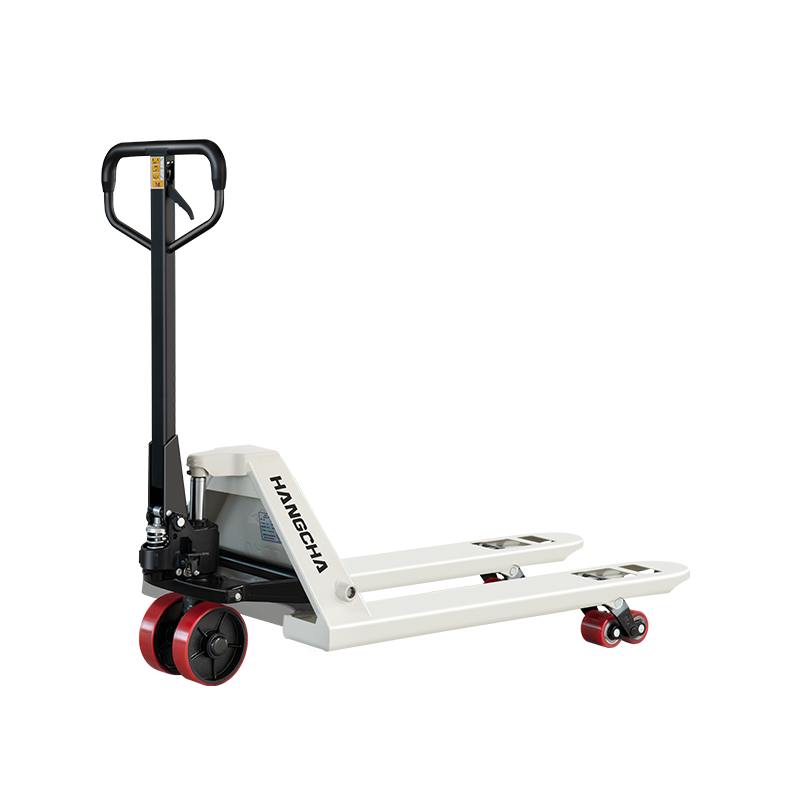
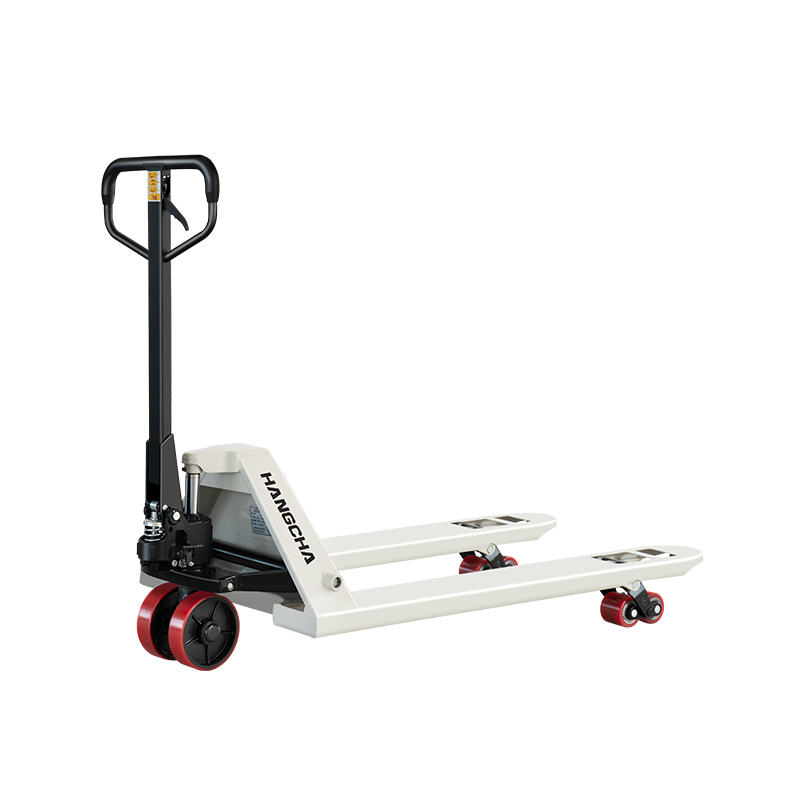
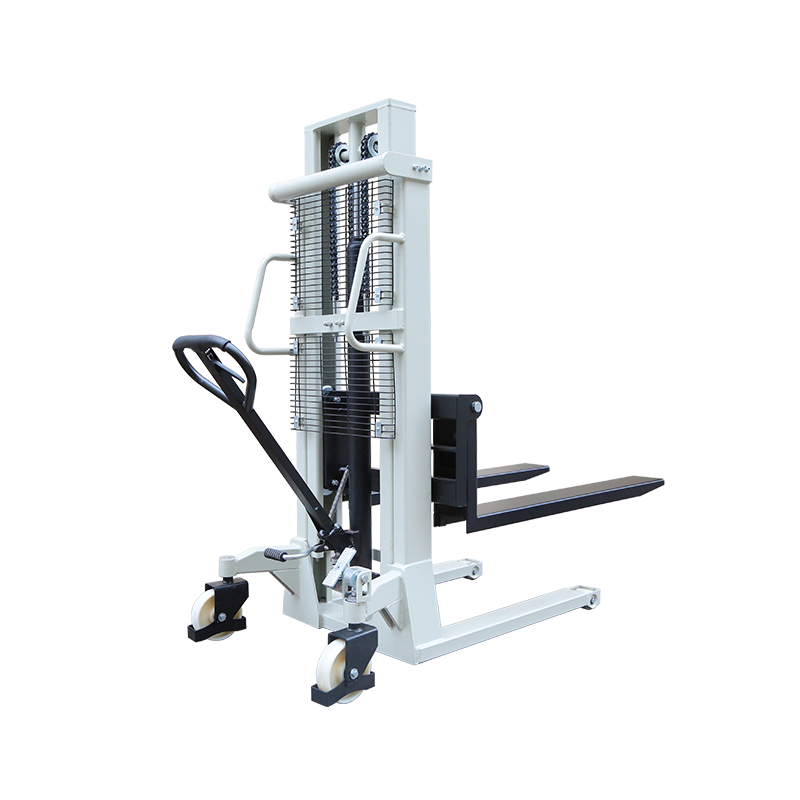
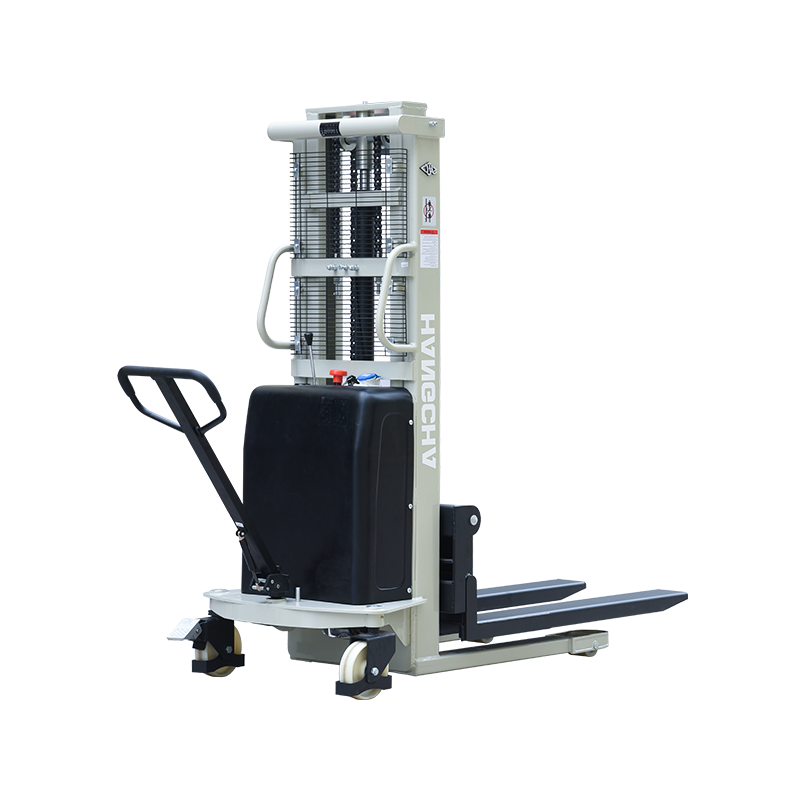
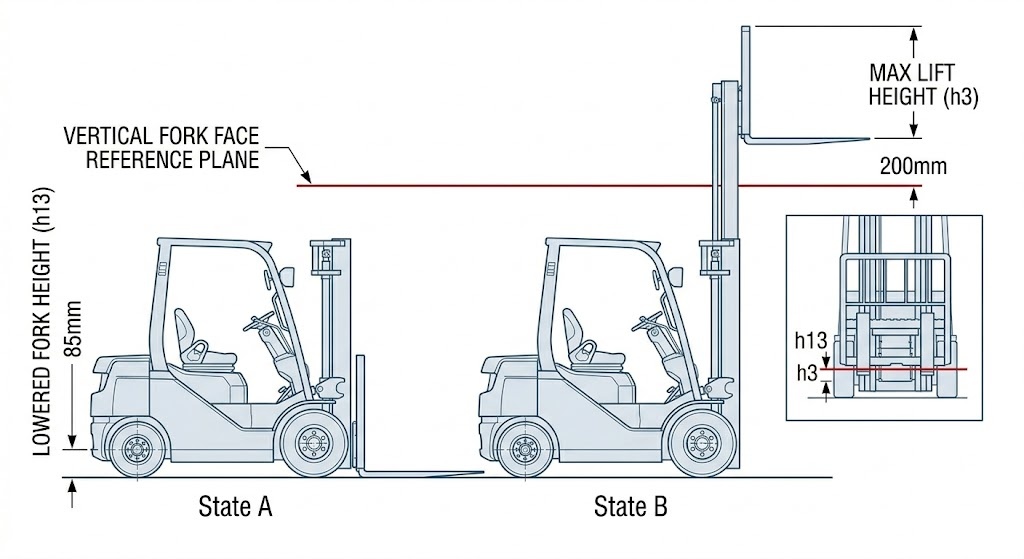
The vertical range of a pallet truck determines its compatibility with various pallet types and transport environments. Understanding these height constraints is critical to preventing Pallet Entry Damage and ensuring smooth transitions over dock levelers.
Standard Lowered Height (h13): 85 mm
This is the global benchmark for standard GMA and Euro-pallets. A fork height of 85 mm (3.3 inches) allows for a clear entry into the 100 mm opening of a standard wooden pallet, providing a 15 mm safety buffer for warped boards or uneven floors.
Low-Profile Solutions (51 mm to 75 mm)
In industries utilizing “disposable” pallets or international crates from Asian markets, the internal clearance is often reduced. A Low-Profile Pallet Jack (51 mm) is a technical necessity here. Without this specific dimension, standard forks will impact and splinter the lead boards.
Standard Lift Height (h3): 115 mm to 200 mm
While the primary goal is horizontal transport, the Total Stroke (approx. 120 mm) is vital. It ensures the pallet clears floor debris, door thresholds, and the steep inclines of Dock Levelers (ramps) used during truck loading.
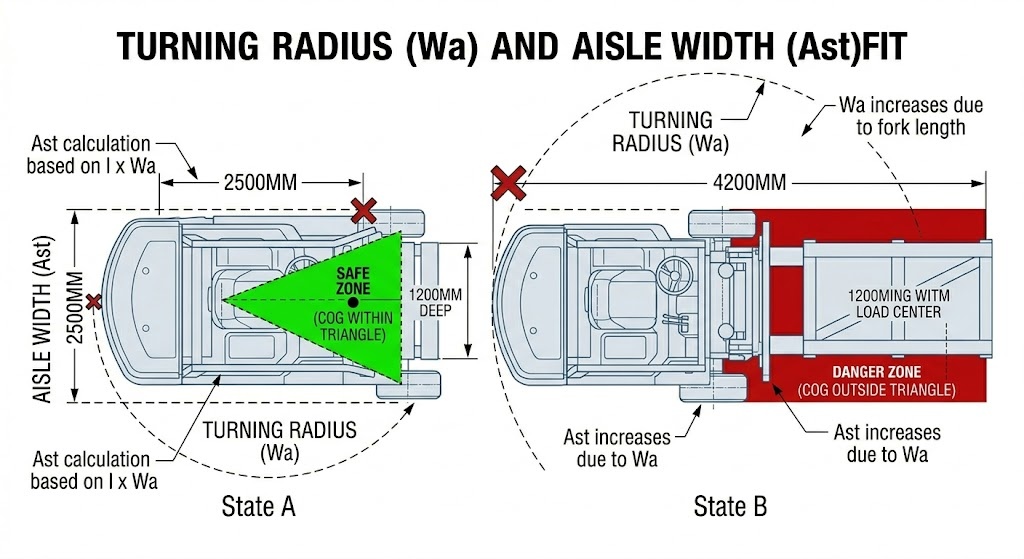
Fork dimensions are not merely about length; they dictate the Turning Radius (Wa) and the Right Angle Stacking Aisle Width (Ast)—the primary metrics for warehouse space planning.
| Dimension Metric | Industrial Standard | Technical Significance |
|---|---|---|
| Fork Length (l) | 1150 mm / 48 in. | Dictates Pallet Support & Turning Radius |
| Overall Fork Width (b5) | 540 mm / 685 mm | Determines Stability during lateral movement |
| Individual Fork Width (e) | 160 mm | Must fit within pallet stringer openings |
| Lowered Height (h13) | 85 mm | Maximum allowable height for pallet entry |
| Max Lift Height (h3) | 200 mm | Ensures clearance over dock levelers/ramps |
Selection Strategy: The Pallet-Fork Gap
Professional engineers follow the 50 mm Gap Rule: Forks should ideally be 50 mm shorter than the pallet depth. This prevents the fork tips from protruding past the rear of the pallet, which avoids hitting the cargo behind it in double-deep storage or cracking the “bottom boards” during pallet exit.
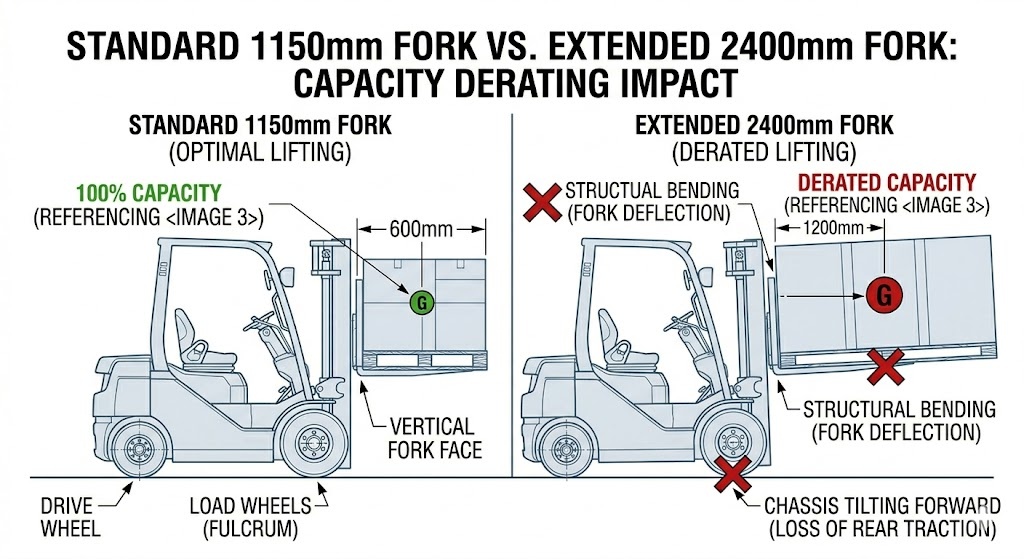
As fork length increases, the Load Center typically shifts forward. This physical shift turns the machine into a lever with reduced lifting capacity.
Calculating Residual Capacity
When using non-standard long forks (e.g., 2400 mm), you must calculate the Residual Capacity to prevent hydraulic seal failure.
Actual Capacity = (Rated Capacity * Standard Load Center) / New Load Center
Example: A 2500 kg truck using 2400 mm forks to carry a long crate (Load Center at 1200 mm):
(2500 * 600) / 1200 = 1250 kg.
Even though the truck is rated for 2500 kg, the physical Moment of Force at that distance limits the safe work load to 1250 kg.
Fork dimensions directly influence how much space your warehouse requires. The Right Angle Stacking Aisle Width (Ast) is calculated based on the fork length and the turning radius of the chassis.
Q1: Why does fork width matter for “Stringer” pallets?
Answer: In 4-way entry pallets, the fork width must be narrow enough to pass between the wood blocks. If the Overall Width (b5) is too wide (e.g., 685 mm), the pallet truck will not be able to enter the narrow side of a standard Euro-pallet.
Q2: Can I use 1220 mm (48") forks for Euro-pallets (1200 mm)?
Answer: It is possible, but not recommended. The extra 20 mm causes the forks to “under-hang.” This often leads to the load wheels dropping onto the pallet’s bottom boards rather than the floor, which can crack the wood or stall an electric drive motor.
Q3: How does fork length affect electric drive traction?
Answer: Long forks move the center of gravity forward. This creates a leverage effect that lifts the rear drive wheel. If the drive wheel loses pressure against the floor, you lose Braking and Acceleration Traction, especially on ramps.

+86-0571-88131206

+86-19084200370

+86-17816721301
 عربى
عربى